Showing posts with label Aliyah. Show all posts

11/04/2012

Comments on the Globes Interview with Moshe Feiglin

This interview with Feiglin is fascinating on many levels. A few comments are in order:
1) I think his views on non-Jewish citizens of the State of Israel are simply horrifying. He argues here that it's not racist to want to make them second class citizens because deep down they know that they're second class citizens.
2) I am extremely wary of someone - anyone - who confuses "my ideas about Judaism" with "Judaism." It's one thing to disagree with R. Elyashiv or R. Ovadiah on some issue within Judaism. It's another to imply that their views are not really the "Jewish" view.
3) I am in almost complete agreement with him about education: parents, not ministries, should have control over a kid's education, and vouchers would be excellent. The one place I part company is on the issue of a core curriculum. Free public education is predicated on the idea that it will make more productive citizens, and thus it is legitimate to condition funding on the teaching of content that will indeed accomplish that goal.
4) He seems to be an advocate of "compassionate conservatism", in which case the interviewer's invocation of Ayn Rand was pretty stupid.
5) I'm not sure how he squares his economic libertarianism with his views on unrestricted school vouchers. I can understand a perspective that wants to completely abolish public funding of schools. I can understand an argument that only core subjects should be publicly funded, and that parents should pay for discretionary education. I can even understand (but strongly oppose) a state that attempts to completely control all aspects of education. I cannot understand a position that is in favor of public funding of education but opposed to any sort of governmental regulation of how that money is spent. That's the worst kind of welfare statism, and completely inconsistent with everything else Feiglin says.

7/10/2012

The Cholent Pot: Between Melting Pot and Salad Bowl

I've taken bits and pieces of old blog posts from here and tried to distill 6 years worth of lessons about being an American immigrant to Israel into a single blog post.For now it's over at TOI. I'll probably post it here in full over the next few days.

5/18/2012

On following the Orioles in Israel

Gary Rosenblatt's column on four generations of baseball fandom in his family got me thinking: those of us who made aliyah may have similar experiences, but with the added element that we are actually purveyors of this facet of American culture to our kids and, perhaps eventually grandkids.
I posted my thoughts on the Times of Israel and Camden Chat.

6/03/2011

A Gilded Landsmanschaft

An article of mine was posted today on Ynet and eJewishPhilanthropy, and was excerpted in Haaretz. The occasion for the article is the dedication of Kehillat Shaarei Yonah Menachem this weekend, with much pomp and circumstance (guest speakers will include Natan Sharansky and R. Shlomo Riskin, as well as local politicians).

In the article, I made reference to an idea that I developed before: that Israel should be a "cholent pot" - not a melting pot or salad bowl. In a cholent pot, each ingredient remains distinct like in a salad bowl, but adds and receives flavor, scent, and texture to and from all of the other ingredients. So too, the different elements that constitute Jewish (and dare I say non-Jewish) diversity in Israel all (should) contribute to and also takes something from all the other elements.

5/26/2011

Balancing Imperatives: A Response to Rabbi Shmuly

After I completed my studies for rabbinic ordination in 2002, my wife and I decided to move back to the United States - temporarily - to teach Torah. Before leaving, we met and spoke with Rav Aharon Lichtenstein. Among the issues we discussed was whether we would have an imperative to stay in a community if it grew to depend on us. He responded with the story of a relative of his who was a shochet, a ritual slaughterer, in Alabama. At some point this man decided that it would be better for the family to move to a larger community. A member of the local community approached him and said, "if you leave, everybody here will start eating treif." R. Lichtenstein continued, "but he had to make the decision that was right for his family. And indeed, kosher food was no longer available in that city."
My own grandparents faced a similar dilemma. In the late 1940s, my grandfather was hired to officiate (lead services, read the Torah, and deliver sermons) High Holiday services at a synagogue in a small town in Ohio. The one-off gig turned out to be a probeh, an audition, and he was offered the job of full-time rabbi. Although he was inclined to accept, my grandmother insisted that she would not move her family to a city with no decent Jewish education. And so they remained in Baltimore.
These stories were definitely part of the calculus that motivated us to return to Israel after 4 solid years teaching in the US. The decision greatly impacted my professional trajectory and ultimately led me to leave the fields of education and rabbinics. Our move was motivated by lots of factors, not least of which was that we did not want our children to grow up with Israel as a foreign country. I will always be an immigrant or alien here. I wanted that experience to end with me.
But during those 4 years, perhaps because we knew that we would only be in the States for a handful of years, we were able to do things that perhaps we otherwise would not have considered. For two years we lived in College Park, MD - something we never would have considered had we been looking for a place to settle. Living on campus while serving the campus community made all the difference, as the campus became our home and not merely our place of work.
Before moving to Maryland, we lived for two years in Dallas, Texas, where we were also willing to explore untested corners of Jewish education there. On one occasion, we spent a Shabbat at the University of Texas in Austin (hook 'em Horns). In many ways, that experience fueled our desire to accept campus rabbinic positions when the opportunity arose.

That Shabbat, we met a student, a senior named Shawn, who had become observant the previous year. I remember being struck by the fact that his trajectory of increased observance did not result in alienation from his peers. Though there were not many role models in Austin, he had somehow managed to keep his balance while undergoing massive lifestyle changes.
Today I have several things to say to Shawn.
The first is: Mazal Tov on your wedding. Tizku livnot bayit ne'eman Be-Yisra'el.
The second is: Keep making great use of your youth and energy! Continue to be a globetrotting warrior against poverty, injustice, and oppression wherever it may be found!
The third and final is: You are now part of a unit that is larger than yourself - a unit that will hopefully continue to grow. This will help you realize that your decisions affect those around you, and that self-fulfillment is not the only variable feeding those decisions. You are not the first and will not be the last to have to chart a course between choosing what is best for the Jewish people, or even the world, and the needs of those nearest and dearest to you (I recommend this post by R. Michael Broyde, which appeared the same day as your article). Be assured that it is not a zero-sum game, though. You will find that balance, just as you managed to keep your balance as a newly observant student at UT. You will meet the needs of your family even at the ends of the earth, if that is the route you choose. And, believe it or not, even if you wind up here in the Jewish state, you will find ample opportunity for development in conjunction with a diverse array of neighboring societies; to play a leading role in fighting injustice, alleviating poverty, advocating for Israel and Jewish interests, and learning from people of other faiths; and to actualize all of the values of our Jewish tradition.

5/14/2011

Am Shalem: The Entire Jewish People

  • I've joined up with R. Amsalem's "Am Shalem" movement as a grassroots organizer, working primarily with the movement's English-speaking division. I have some ideas of where to go with this, and I'll update this blog with relevant news. For some background, here's a feature that Aryeh Tepper did on R. Amsalem w/ JID, and here's a brand new article about Anglo activism in the movement. 
  • Email me (adderabbi at gmail) if you're interested in getting on the movement's mailing list, making a donation, or otherwise getting involved.
  • [UPDATE: tHE SHIUR HAS BEEN POSTPONED. i WILL RE-POST ONCE IT'S BEEN RESCHEDULED] R. Amsalem will be speaking at Kehillat Shaarei Yonah Menachem in Modiin on Saturday Night, May 28. Details to follow, but it has been confirmed.
  • From an article that speaks to these issues and certain key fault lines, there is an emerging dispute about whether Lag B'Omer should be celebrated this year on the 33rd or 34th day of the Omer. The reason to postpone is to prevent Shabbat desecration during preparations. The Ashkenazic Haredi authorities are not in favor of postponing, but the Sephardic rabbis generally are. In my opinion, this dispute falls along a fault line of "secessionist Orthodoxy" that goes back to the austritt days of R. Hirsch. Basically, does the halakha address the community of the self-defined faithful, or does it speak to the entire Jewish people (the Am Shalem, if you will). My grandfathers both ministered to the non-observant, and one grandfather studied in the Wurzburg Seminary founded by R. Seligmann Baer Bamberger, the disputant of R. Hirsch on the austritt issue. It is clear where my sympathies lie.
  • And finally, speaking of my grandparents, I will be giving my annual yahrzeit shiur in memory of my three grandparents who passed away during Sefirat Ha-Omer. The shiur will take place on Tuesday night at 8:30pm at the Glenwood Synagogue in Ramat Modiin (Hashmonaim). The topic is: "A Path through the Graveyard: R. Shimon b. Yochai's Return to Society" - and yes, the topic will very much have to do with the themes discussed earlier in the email.
Two other short notes:
  • According to Blogger, this is my 1000th post.
  • I think I'd really enjoy this album

9/07/2010

Steak n' Slichos

Last night/ this morning, I went with my father and my nephew to Jerusalem for our annual Erev Rosh Hashana 'Steak n' Slichos.' We have a late dinner of entrecote at Vaqueiro. We then head down to the Kotel for selichot at the astronomical midnight. I'll admit that the idea of steak and selichot is an expression of contemporary suburban religious sensibilities - conspicuous consumption followed by a devotional pilgrimage. But I like it.

The Kotel was jam packed, and there was a real diversity there. I happen to love the cacophony of different traditions that you get there. Some find it distracting, and if you're looking for a focused davening, I suggest the Hurva, a few steps away. I like the jumble of Jews trying to outshout each other. Since we got there about a half hour before astronomical midnight, I joined a kumzitz organized by Yeshivat Eretz Hatzvi. It was nice to see lots of people stop and join in. It was just. really. nice.

Before descending to (or after ascending from) the Kotel plaza, you can see - it's really quite amazing - the Jewish throngs saying selichot at the Kotel and the Ramadan break-fast celebrations taking place in Silwan, just a few hundred meters away. Looking out over the"Holy Basin" and watching Jews and Muslims observing their religions separately and peacefully, it's easy to forget how many wars have been fought over this very piece of real estate.

Living in Israel, it's impossible to avoid the holiday season. The whole rhythm of life builds up to Rosh Hashana - colleagues and friends send out cards, synagogues have their annual membership drives, schools send home songs and honey dishes, radio stations count down the year's best songs, and journalists review the highlights and lowlights of the past year. In this environment, it is inevitable that we take stock of our lives. My birthday - always a time to review life - falls out on the second day of RH this year, exacerbating my brooding and introspective mood.

I won't share everything I've been taking stock of, but I will share my resolution (kabbalah) for this RH - I will not talk sports in shul anymore. If it seems a bit prosaic, it's because it's manageable. I've begun to feel that the topics of conversation in shul - and not just the bein gavra le-gavra talking - is too shallow. Shul fills an important social role in my life and in the lives of many others, as it should. Talking in shul - not necessarily during davening - is inevitable and even encouraged. I've found that sports have become a sort of "default" - a way to make conversation without really trying to get to know the other person, of "talking without speaking." So if I cut out sports in shul, I expect good things to happen (I'm not in shul now, though, and the O's are beating the Yanks for the second night in a row [UPDATE - Buck-O's win again] - 4 in a row vs. the Yankees and Tampa Bay if they hold on).

Together with you, readers, I look forward to a happy, healthy, and productive 5771. Le-shana tova tikateivu ve-teichateimu.

8/01/2010

Quick Takes I


Migrant Workers

Israel has decided to allow most children of migrant workers to stay, and to expel others. It could have been a lot worse. I was truly afraid that they'd expel them all. At some point, I hope we realize that having a Jewish State has nothing to do with the relative proportions of Jews and minorities. Our Nevi'im envisioned a state founded on certain cardinal values, not a state with a Jewish majority. [Further reading]


Interns

Tablet Magazine is looking for interns to work in NYC. A word of advice, instead of overpaying for some just-out-of-college wannabe journalist in New York, you can get much more bang for your buck in Israel. There's a heckuva lot of talent in the Jewish State, and it's much cheaper than in New York. Jewish Ideas Daily has figured this out. And frankly, after a hot start, the quality of writing at Tablet has really deteriorated over the past few months. Aim high, guys.


Conversion

Regarding the conversion issue in Israel, I think that putting conversion in the hands of local rabbis is a positive step, but ultimately not far-reaching enough. On a fundamental level, there is a problem when marriage and divorce are controlled by a religious body that does not have the buy-in of large swaths of the population. The only answer is the institution of civil marriage and divorce. People have figured out how to privately check yikhes for centuries without the Rabbanut's help. And if anyone out there wishes to get civilly married outside of Israel and wants an Orthodox rabbi to officiate at a non-Rabbanut ceremony in Israel, let me know. [Further reading]


Statement of Principles

I signed the SOPOTPOJWAHOIOC. Do I agree with every last formulation, implication, etc.? Of course not. But it's crucially important that it be made crystal clear that there is an Orthodox alternative to homophobia, condemnation, and recommendations for conversion therapy. [Further reading]


Conservative Name Change

Apparently, the Conservative Movement is contemplating a name change, and Traditional and Masorti are the leading candidates. I say just leave it. "Conservative" might be a poor descriptor, but so are the rest. Personally, I can't stand the term "Orthodox," but at some point you just accept it and move on. [Further
reading]

3/31/2010

Chol Ha-Mo'ed Advice and some People Watching

In Israel, the Jews are the Goyim and the entire country is flooded with vacationing families during Chol Ha-Mo'ed. Over the year, I've developed some strategies for avoiding the major crowds, though it is somewhat impossible. The main two strategies are a) go to places that are only accessible by car, and b) go to places that cost money. Each of these criteria limits the popularity of sites. A third strategy is - stay relatively close to home. Traffic can become a nightmare.

Today we went to the Tisch Family Zoological Gardens, aka the Jerusalem Zoo. We saw some amazing elephants (pilei plo'im!), some really nasty ties, some meerkats, and some shababnikim (Mir-cats).

By far the most amazing exhibit was the moron exhibit. It was incredible to see so many morons in their natural habitat. I saw one moron get stuck trying to pass a stroller through a revolving door. Another particularly talented moron threw an orange at a lion - and actually hit it. There were several examples of moron-spawn encroaching on the territory of the other zoo animals.

This was indeed in direct violation of a) above. My arm was twisted.

1/15/2010

Your Gates shall Always be Open

My cleaning help put me to shame this week. There was an almost mythic time in Israel where it could be assumed that even menial workers - street sweepers, milkmen - knew Tanakh or were Torah scholars. I had such a moment with the cleaning help. The surprising part is that he's a Nigerian Christian (more precisely, he's a Biafran Igbo Pentecostal and believes himself descended from the tribe of Ephraim). He's also an informal pastor of sorts, spending a lot of time on the phone with people who call him for advice.

When I picked him up at the bus stop this week, I asked him what he thought about Israel's plans to build fences along the Egyptian border. I was truly curious about what he would say about the matter: on one hand, I could see him favoring Israel's measures as illegal migrants are the greatest threat to the livelihood of the legal ones. In addition to flooding the market with supply and thereby driving wages down, an increase in immigrants can create a backlash from citizens, who would be unlikely to differentiate between West Africans (excl. the Maghreb) and those from the Horn of Africa (incl. the Sudan).

On the other hand, I could imagine that he would want Israel to keep its borders open, either to provide asylum for refugees (and tolerate the migrant workers who came along for the ride) or because he believes that the migrant workers themselves should be given the opportunity to do hard work for decent pay.

He answered me by saying that the Bible says that multitudes of nations shall come into Israel, and that Israel may not close its gates. I asked him if that's from Zechariah, and he answered no, it's from Isaiah 60. We left it there, but I later went and looked it up.

To my shock and embarrassment, Isaiah 60 is my Bar Mitzva haftara (Ki Tavo), and it says precisely what he quoted:
וּפִתְּחוּ שְׁעָרַיִךְ תָּמִיד יוֹמָם וָלַיְלָה, לֹא יִסָּגֵרוּ:  לְהָבִיא אֵלַיִךְ חֵיל גּוֹיִם
 And your gates shall always stay open; day and night they shall never be shut - to let in the hordes [possibly] of nations (Isaiah 60:11)
Granted, in fine tradition, F. ripped this verse out of context (no need to take my word for it; read the chapter). Nevertheless, his response contains a very profound truth that we seem to have lost sight of here in Israel.

Discussions about the entry of non-Arab non-Jews into Israel inevitably raise the issue of the integrity of the Jewish state and the demographic threats that it faces. Isaiah and other prophets, and F. in their wake, understand that a Jewish state need not have a Jewish majority. I would add that the converse is true as well - having a Jewish majority does not mean that it is a Jewish state.

Obviously, it is always problematic to apply an apocalyptic vision to a very contemporary situation. Nevertheless, it can be valuable, not only in that prevents us from losing sight of the ideal in the face of the real, but because it may even have practical ramifications.

The gentiles coming to Israel of their own volition - be it from the Phillipines, West Africa, the Horn of Africa, Eastern Europe, Thailand, or anywhere else - are looking for freedom, economic opportunity, or both. These people appreciate what Israel has to offer. They choose to come here despite the bureaucracy and virtually impermeable barrier to citizenship (after all, not even marriages of convenience are permitted). Right now, they are building this country (see ibid. 10) and are willing to do the work that Israelis are not. They are the new kibbutzniks.

Moreover, they overwhelming acknowledge Israel as a Jewish state, de facto if not de jure, and some, like F. and his flock, believe Jewish sovereignty here to be ordained by God (and should be welcomed no less than American Evangelicals who believe similarly). They are loyal to the State of Israel, if not outright Zionists.

Were Israel to open the floodgates, it would create a natural population buffer between Jews and Palestinians and ensure that neither becomes a tyrannical majority (possibly paving the way for a workable and peaceful one-state solution, but that's an issue for a different time). Of course, as this group assimilated into Israeli society - becoming citizens, serving in the army, etc. - some serious matters of personal status would have to be resolved (a caste system or legally-enforced Jewish endogamy would become unworkable, if they are not already).

At the very least, it is worth considering how keeping our gates open can transform Israel into a state in which Jews are not a majority, but which is in keeping with the prophetic vision of the Jewish state.

12/02/2009

My article on Jack Tytell

This article was born in the following way:

After reading numerous articles and opinion pieces (for a particularly egregious example, see Gershom Gorenberg's piece here) that seek to blame the settler/ national-religious/ American Orthodox olim community for creating a monster, and after having heard several anecdotes about Tytell's early years that seemed to run counter to that presumption, I pitched an investigative piece to several well-known media outlets. The Jewish Week expressed interest (others also expressed interest, but either didn't have a mechanism for dealing with freelancers or simply wanted me to give them my sources), and we were on our way.
Clearly, as an American Orthodox oleh, I have an interest in deflecting blame away from my community, even as I readily acknowledge that this community tends to have more loose cannons than others. Nevertheless, the article is the product of dozens of hours of research, interviews, and cross-checking that gives the article a degree of veracity that goes well beyond anything you will see in any other article out there to date (starting with the fact that I spell his name correctly).

Readers are invited to leave comment here, since the JW does not yet have such a forum.

6/01/2009

Ushpizin on Shavu'ot

Since making aliyah, we have instituted a custom in our family regarding the night of Shavu'ot. Our meal is graced by the presence of two very important guests who truly enhance our simchat Yom Tov. Their names are Ben and Jerry.

The wife and I each gave a shiur over Yom Tov - the same shiur, more or less, in fact. It's an expansion of this. I generally don't stay up all night anymore. Maybe when the kids are older (more on that below). I made sure to give the shiur at a time that I could still get a decent night's sleep. I had the 12:40- 1:25 am slot. It went very well - there were a lot more people than I expected (I printed 20 source sheets, and there was not even enought for people to double up). The problem was, I got so jacked up on caffeine before the shiur that I could not fall asleep afterward.

My favorite Shavu'ot memory: I must have been 10 or 11. My father and I were learning mishnayot in the wee hours on Shavu'ot morning, in the basement of the shtiebl on Park Heights Avenue, AC on full blast, soda and chips in reach. We got up to the following mishna (Bekhorot 5:3):

One some children were playing in a field, and they tied the tails of two lambs together, and the tail of one of them was disconnected - and it was a firstborn. The incident came before the sages, and they permitted it. They went and tied the tails of other firstborns, and they forbade it...
I remember poring over the books, trying to figure out (er, make heads and tails?) out of the text, and then we get to this little anecdote, and we just lost it. We probably laughed for 10 minutes, imagining these kids tying the tails of sheep together. So what's your 'all time favorite mishna'?

4/29/2009

Toasted and Exhausted

My neck and face are sunburned.
It is early evening, but I'm exhausted.
After a festive davening, a hike around some local ruins, some time watching the kids bounce around on big inflatable toys in a cul de sac inhabited by friends, and a barbeque with friends all afternoon (1/2 hour drive away), I'm beat (the beer didn't help).
The highlight was the following:
On the drive home, Child A started complaining that Child B had leaned over and licked her lollipop. I pointed out that the lollipop remained intact, so she could continue eating it. She said she didn't want Child B's germs. I asked: "Would you like me to link his germs off?". She agreed. I took a lick of the lollipop and returned it to Child A, who happily continued to eat it.
All the while, Child C was giving himself zerberts on the soles of his bare feet.

I miss Sundays.

3/24/2009

Book Review: Siddur Shema Koleinu

I recently was introduced to this book because its publisher, Amit Sofer, is a friend and neighbor of mine in Modiin. As a musician, he often found himself in a situation that he was taking his kids to school late, and davening with them in the car because they would miss it in school. This situation gave rise to the Siddur Shema Koleinu.

Many contemporary children’s have sound filed embedded. This siddur has about 15 minutes worth of audio in it, and it contains most of the basic prayers that children say in school and at home. Some of its 16 tracks are simple recitations (Birkot ha-Shachar, Shema), but others are full-fledged songs (Adon Olam, Yigdal, Hamalach).

I’ve found that this siddur helps children with pronunciation and reading skills as they follow along in the text as they listen. It is highly recommended for a family contemplating aliyah that wants to get their kids used to the style of davening in Israeli preschools. It would also be a wonderful addition to Jewish preschools in America. I bought a few to give as gifts to preschoolers who are just learning the rudimentary prayers.

Batteries are not included.

2/10/2009

Done my Duty

I've now voted in the Israeli general election. The only other time I voted nationally was during the Prime Ministerial election of 2000, when Ariel Sharon defeated Ehud Barak in a landslide. I have never before voted in a Knesset election.
I brought the kids along to show them how it works. I remember going with my mother to the polls when she voted for Reagan over Carter at Northwestern Senior High School in Baltimore, MD.
At our polling station (about a block from our house), a group of activists from the Meimad-Green party were outside, canvassing for votes. MK (though probably not for long) Rabbi Michael Melchior was there, and I introduced my kids to him. I like Rav Melchior. I think he's a really good guy, and probably the best role model for what a rabbi's role in government can and, perhaps, ought to be. He's also the closest thing that Israel has to a UK-style Chief Rabbi.
I didn't vote for him (ED from RBS - don't worry!), but I want my kids to see him as a true role model. Unfortunately, he asked my older son whether he's familiar with two Israeli kids' TV-show characters (can't remember the names, something like Izzik and Gizzik). We don't have a TV, and my kids was totally confused (I was, too, honestly). Whatever. A noble attempt to establish rapport with a 4-year-old, but sort of an anticlimactic.
The older 2 kids got to put the envelopes into the ballot box, which made them feel part of the process.
I've been hearing about a lot of people who had been considering voting for a satellite right-wing party, but who switched back to Likud in recent days out of concern that Likud would lose its lead. I would not be surprised if the Likud outperforms all expectations as a result, but that may just be wishful thinking.

UPDATE: Apparently, I was not the only one to notice Rav Melchior in Modiin (link).

12/28/2008

Ah, Sunday

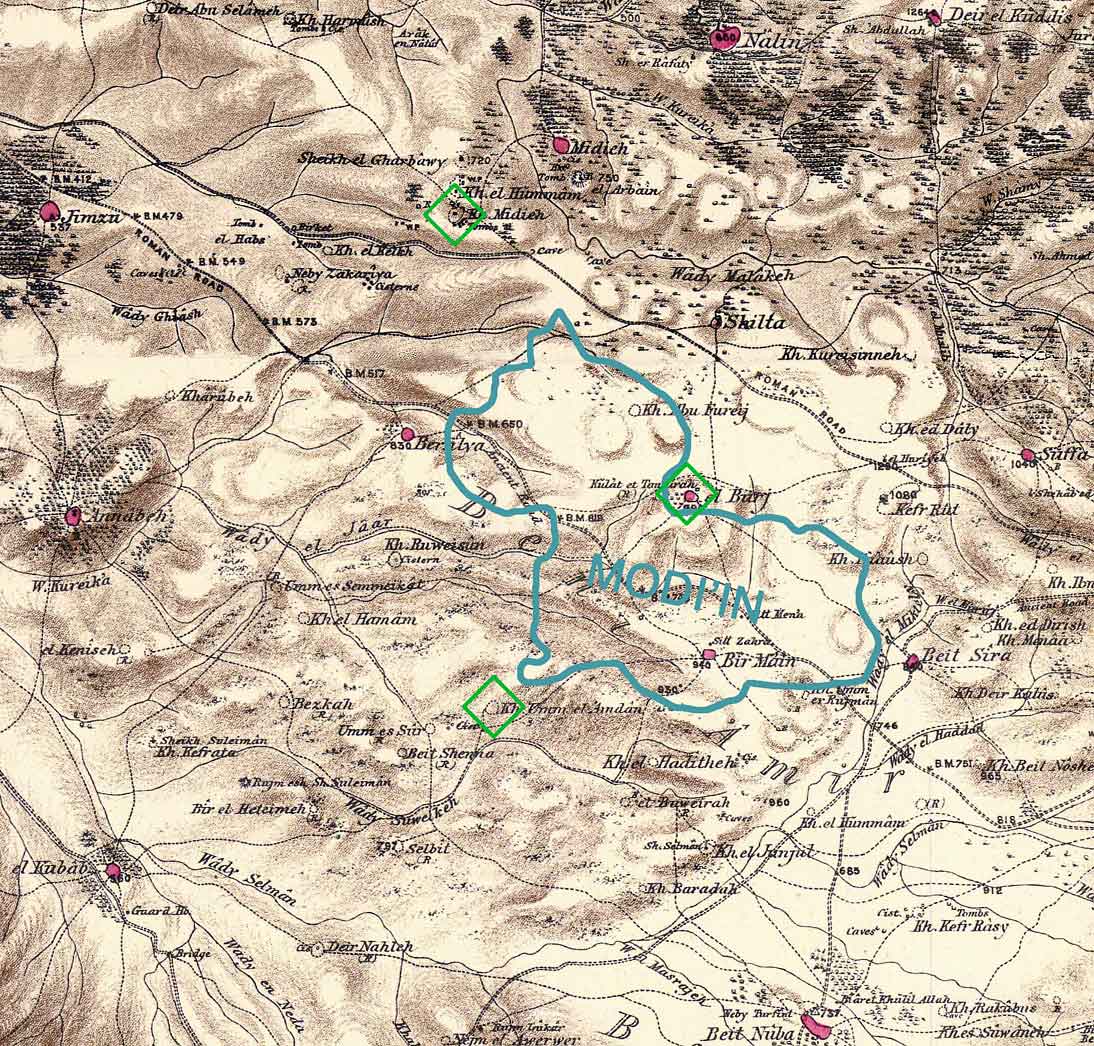
The wife and kids were off today for Chanukah vacation so I took off as well. We woke up late, went on a short hike about a 5 minute drive from our home where we visited the ruins of a Byzantine church and two agricultural villages - one from the Byzantine era and one from more recently (the ruins were about 60 year sold or so). The landmarks can be seen just below the border of modern Modiin on this map - look for Haditheh and Baweirah. We live just at the corner of modern MOdiin, near the box marked Umm al Umdan.

After the excursion, we went to the supermarket to pick up a particular gift that will be presented later tonight, but also treated ourselves to sufganiyot.

Then we went to watch my nephew's Little League baseball game - his team, from Hashmonaim, played against the team from Modiin; the epic Chanukah battle ended in a 9-9 tie.

After we finish bathing and lighting, we will be headed to my folks' home for our annual Chanukah shindig with the extended family.

The night will conclude with that traditional combination of beer and foootball, and I will probably be up late watching the Ravens game (unless the Patriots lose the early game; even if they win, I don't want to hear any Pts fans whining. They had a softball schedule, playing a full 8 games against the AFC and NFC west).

Sundays happen so infrequently here, but when they do present themselves, they are truly enjoyable. So enjoy this happy conflation of Chanukah, Rosh Chodesh, and Sunday!

Kind of makes you forget that a war just started here...

12/14/2008

Rabbi Mendel Feldman, ob”m

Yedidai,
It is with great personal sadness that I note the passing for Rav Menachem Mendel Ha-Kohen Feldman, ob”m, in Sydney, Australia.
I was fortunate to have known Rabbi Feldman in many different contexts. When my father spoke of “Rebbi”, he meant Rabbi Feldman. Later, Rabbi Feldman became the rav of Khal Ahavas Yisrael Tzemach Tzedek, a shtibl (now with a proper building) on Park Heights Avenue, a block away from the house where I grew up. That was our shul for about a decade, from when it opened until the family made aliyah, like a number of Rebbi’s other close talmidim, in 1995. A few years after opening the shul, the Feldmans moved to a condo one floor below my grandparents’ on Park Heights.
An illness prevented him from being mesader Kiddushin at my wedding, but he spoke at Sheva Brachot and blessed the young couple with Birkat Kohanim, which was his trademark to the degree that it is possible for that ancient blessing to be the trademark of one person. In my mind’s eye, I can recall lining up after shul on Friday night, when all of the children would line up and be individually blessed by Rabbi Feldman. I still see the wispy ends of his never-shaven beard resting on his plain black frock coat, and still even smell him, as I bend my head to receive Rebbi’s Birkat Kohanim on Friday night. I remember doing the same at my Bar Mitzvah. In addition, he was Koreh Shem at my brit milah, and read the ketubah at the wedding of my parents. I remember my father lining up behind all of the children on his last Friday night before making aliyah from Baltimore. I remember Rebbi reaching up to give my father his bracha; they were both crying. He also lent my father a pair of Tefillin aliba de-Rabbenu Tam, so that his physical aliyah would be accompanied by a spiritual aliyah. My father still wears Rabbenu Tam tefillin daily (he bought his own set a year later). The following picture is of Rabbi Feldman being podeh my eldest nephew:
Rabbi Feldman, who passed away at the age of 89, was born and lived almost his entire life in the United States. He grew up in New York and studied in Yeshivat Tomchei Temimim, under the guidance of the previous Lubavitcher Rebbe, and at Mesivta Torah Vodaas. After a short stint as a rabbi in Jacksonville, FL, he moved to Baltimore with his wife, Rochelle/ Rochel (nee Simpson), where he served as a Rebbi at the Talmudical Academy and succeeded Rav Shimon Schwab as the Rav of Shearith Israel (the “Glen Avenue Shul”), where he served for over 25 years. After his retirement from AYTT after two decades, the Feldmans emigrated to Australia to be near their son, Rav Pinchas Feldman, Chief Chabad Rabbi of New South Wales, Australia. Rabbi Feldman outlived his wife by several years.
He made the greatest impression, though, with his personal humility, care and concern. He was never a charismatic speaker (though each of his drashot opened with “Yedidai” and ended by expressing belief in the impending arrival of “Mashiach Mamash” – I do not know if that practice continued after the passing of the Rebbe, ob”m), but he attracted a very loyal and devoted following in Baltimore with his warmth and humor, by being accepting and offering guidance to his devotees. Once he became a person’s Rebbi, he remained so for life. He was also an active member of Baltimore’s Beit Din, especially with regard to matters of giyur and gittin, and the chavruta of Rav Moshe Heinemann.
An aspect of his personality which often flew under the radar, especially in Baltimore, was his Ahavat Eretz Yisrael. A significant number of his devotees made aliyah, and he took a tremendous amount of pride in their decision. On one of his last visits to Israel, his former students met with him at a restaurant, and reported that they had never before seen him in such a state of ecstasy.
Tehe Nishmato Tzerura be-Tzror ha-Chayim.

9/08/2008

Rav Gustman, zt”l

This past Saturday night, I had occasion to attend a simcha at Netzach Yisrael, the yeshiva in Rechavia, Jerusalem, which Rav Yisrael Zev Gustman, zt”l, founded and led until his death in the early 1990s. I was with my father, who had studied in Rav Gustman’s yeshiva before it migrated, with its head, from Brooklyn to Jerusalem in the early 1970s. I met Rav Gustman, the only pre-war Gadol that I ever met, in that building on Tisha B’av, 1987. This led to an impromptu discussion of this largely unheralded great man and his legacy.

The stories told about Rav Gustman are the stuff of legend. Having learned through some of his lengthy but intricate and brilliant shiurim, I can attest that it is not for lack of substance that stories about him tend to focus on his great sensitivity , sense of perspective, and unconditional love (except for the stories about his joining the beit din of R. Hayyim Ozer as a teenager). Many of these stories are recorded on-line. I heard most of them well before the internet became the vehicle it is today:

  1. Perhaps most famous of all is the story of when he went to be menachem aveil as Prof. Yisrael Aumann sat shiva for his slain son during the First Lebanon War.

  1. Rav Gustman would water the plants at his yeshiva out of a sense of gratitude to the bushes that hid him when he hid (the above linked article says that he hid in the bushes from the Nazis; I heard that he hid in the bushes as a younger man to avoid conscription).

  1. He used to take joy in seeing children rejoice in Israel, saying that anyone who saw children die in the Holocaust had an obligation to watch them play in Jerusalem.

  1. I’m pretty sure I heard this from David: Rav Gustman and ylcht”a Rav Aharon Lichtenstein made aliyah at around the same time in the early 1970s. During the Yom Kippur war, RAL was assigned by Home Front Command to deliver milk in Jerusalem. As Rav Gustman was on his delivery route, RAL took the opportunity to “talk in learning” for a while when delivering the milk. Rav Gustman, legend goes, exclaimed after the encounter: “What an amazing country! Even the milk-men are talmidei chachomim!”

  1. Rav Gustman opened the doors to his yeshiva in Brooklyn at the height of Vietnam conscription to allow more kids to take advantage of the draft exemption that clerical studies offered. No, I’m not 100% comfortable with that. But hey, I live in a very different country at a very different time fighting very different wars; I have no doubt that Rav Gustman sacrificed the level of learning at his yeshiva, something many others would not have been prepared to do, to take these kids in; and the United States has elected two presidents who just as legally but just as dubiously avoided conscription to Vietnam.

  1. He used to shovel the snow in front of the yeshiva – and when students and baalebatim began complaining that he was embarrassing them by doing so, he started doing it while it was still dark outside.

As these stories passed around the table, there was one fellow who offered the following:

Rav Gustman once killed an Amaleki.

Noticing my incredulous look, he continued:

He met an Amaleki, knew what the simanim are, and killed him.

I said that I didn’t believe him. He elaborated further:

Yeah. He was in the forests in Lithuania during WWII, and he met a German with the simanim.

Now it made sense. I suggested, partly in jest, that the “siman” in question was a swastika. The fellow didn’t get my drift, saying that the signs of Amalekhood go back much further than the swastika.

More than anything else, I was appalled that, for this fellow, the ability to identify and then murder an Amalekite (with no other context readily apparent) is the stuff of heroism. I don’t take the story as any type of reflection on Rav Gustman himself. That's not the Rav Gustman that I grew up hearing about.

8/19/2008

The “Bounty of Spain” Meme

It would be easy for me to abandon all the bounty of Spain; as
It would be precious for me to see the dust of your destroyed shrine.

I considered entitling this post “The Things They Carried”, but I figured that an equation of aliyah to Vietnam is inappropriate. Instead, I lifted a line from the end of R. Yehuda Halevi’s famous poem, “Libi be-Mizrach”, in which he articulates how he prefers the dust of Israel to everything that Spain has to offer.

Nowadays, one need not leave all the bounty of Spain. Pretty much any bounty is available in Israel, albeit more expensive. Most olim, however, indeed abandon much of the bounty that is America when emigrating to the (I Never) Promised (You a Rose Garden) Land. We yet prefer the dust.

Nevertheless, every oleh that I know has a list of products that he/she still insists on obtaining from across the pond. Some of those products are relatively common, and some are individuated to the tastes of the specific consumer.

As I prepare to return to the erstwhile rose garden, and as my contribution to the Blogapalooza that will be taking place in Jerusalem tomorrow, I hereby launch the “Bounty of Spain” meme, which will list five items that an oleh personally imports from the alter heim. Here goes:

1. OTC pharmaceuticals (ibuprofen, loratidine, naproxen, kid’s chewable stuff)
2. Computers (including accessories – SO much cheaper, especially when buying refurbished from a reliable source)
3. Clothing (we’ve found that the cheap stuff in the U.S. is cheaper and lasts much, much longer than the cheap stuff in Israel; shoes are included in this category. I just bought me a pair of Rockport Prowalkers for a real good price).
4. Peanut butter
5. Toys
And here’s an extra:
6. Don Pepino Pizza Sauce – yeah, there’s the wild card; it’s just so good.

I tag: Jameel, Ben Chorin, Rafi (for a British perspective), Sarah (one of the Rebbetzin’s favorites).

8/11/2008

The J-Blogger Convention

Almost everybody missed the first annual Pocono J-bloggers Convention this past Friday. It was sponsored by Wal-Mart of Honesdale, PA. Participants included myself and Menachem of Seforim and Michtavim. We barely recognized each other behind the accumulated facial hair. It was inspiring.

I will not be participating in the NBN blogger’s convention. I’ll be on my way back from the U.S. then. Funnily enough, I blogged our own aliyah 2 years ago, without the hype. They had an “embedded” blogger on that flight, and didn’t even know it. I’ve posted quite a bit about the aliyah experience, about life in Israel in general and Modiin in particular, and about Zionism. See the labels. Maybe next year.