10/11/2006

Two Minutes with R’ Scheinberg?

I davened at the Kotel this morning (the real one, not the one in my house). While there, I saw R’ Scheinberg being wheeled around there. I was wondering, if I could get over to him and fight through the bachurim, what would I ask him?

There are lots of options: I could have asked him about his quoted position on the Kolko affair – what did he really say/mean? I could have asked him about his father-in-law’s alleged discovery of the keilim of the mikdash, as recorded in ‘All For the Boss’. I could have asked him about a lot of things that he’s been involved in, and that I have lots of questions about, but that won’t get mentioned here.

But I decided that I’d ask him about the Kiddush he made in honor of his not having gotten and hana’ah from hearing of a Yankees World Series victory. I’d have told him about the Yankees debacle against Detroit with a bit of zest, then asked if I’ve caused him any agmas nefesh with the news. If not, then maybe it’s time for another Kiddush. If yes, then I will have rubbed it in a Yankee fan’s face. It’s a win-win.

10/09/2006

The Yetzer Hara to Teach Torah

I’ve got a terrible yetzer hara to teach. That one of the reasons I started this blog, after all. I’ve got ideas, and I want to share them. This yetzer can be altruistic, but can also contain elements of hubris, desire for attention, recognition, or adulation, and even a desire to ‘control’ other people. Even if it’s altruistic, there a danger of trying to ‘monopolize’ the Torah, or to blur the lines between Torah and ‘what I think’, or to confuse my necessarily limited view of Torah with ‘what the Torah says’.

There are a number of ways to ‘deal’ with that yetzer and avoid its pitfalls, but I really can’t speak for others when talking about coping strategies. My assessment, and I could be totally off on this (but I don’t think so), is that most people with this yetzer are in denial of its existence. As C.S. Lewis dramatizes in The Screwtape Letters (ADDeRabbi’s pick for ‘Best Mussar Sefer Ever’), the best way to tempt Man is to have him believe he’s not being tempted. I’ll reserve my list of ‘dos and don’ts’ for another time.
There’s a new dilemma that this yetzer has presented, though – getting involved in teaching and speaking here in Modi’in. The ‘established’ presence in town is the B’nei Akiva circles – the Hesder Yeshiva, the Yeshiva High School, the elementary schools, girls high school, and shuls in that orbit. I’m not a card-carrying member of that basic R’ Kook-Mercaz ideology, so fat chance of breaking in to that circle. I can try setting up a different adult educational model, but that seems like something that would require more time, effort, and money than a hobby. Can’t afford that, so I’ll stick with blogging.

So I tried playing the ‘American’ card. There’s a communal ‘leil Hoshana Rabbah’ learning program sponsored by that nexus of institutions I just mentioned. I asked if I’d be able to give a shiur, and got a very cold response. Then I mentioned that there’s nothing in English for the extensive English-speaking population, which includes a number of guests for Yom Tov. And then the doors started opening. One person put me in touch with another, who put me in touch with the organizer, who basically handed me the job of organizing a parallel ‘English’ track.

OK, it’s a tad subversive; but it gets the foot in the door, and doesn’t undermine anyone. Would it be too much to have a female speaker?

10/07/2006

Sukkot on Campus: Some Strange Applications of Teshvu Ke-ein Taduru

Last year, we spent all of Sukkot at home in College Park, on campus. I don’t think I’ll ever have a Sukkot like that again. There were several highlight, but one stands out above the rest.
One highlight was helping the local chapter of AEPi build their Sukkah. They built it, then partied in it. Teshvu ke-ein taduru. They were even thinking of having the freshmen pledges make paper chains to decorate it.
For Hoshana Rabbah, I went and cut a ton of aravot that grow alongside the Paint Branch Creek, right outside Comcast Center. It was a lot of fun driving a car full of willow branches smack-dab through campus. There were a lot of knowing looks and nods. Everybody knows about the Jews and their leafy twigs in the fall.

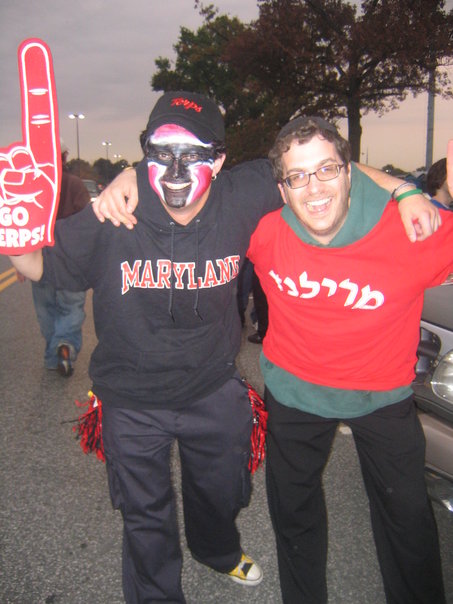
The best was the result of several fortuitous circumstances. Maryland only plays 6 or so home football games each year. They are generally on Saturday afternoon. About every two years, they play a home game on a Thursday night. Last year, they played such a game and it fell out on Chol Ha-Mo’ed Sukkot. That meant that any Jewish student who could get a ticket would be going to the game. Add to this that UMD was going to play #3 Virginia Tech, with potential national championship implications, and that it was going to be nationally televised by ESPN, and you’re talking about a huge party in College Park. Maryland students wore black – to distinguish themselves from the burgundy wearing Tech fans.
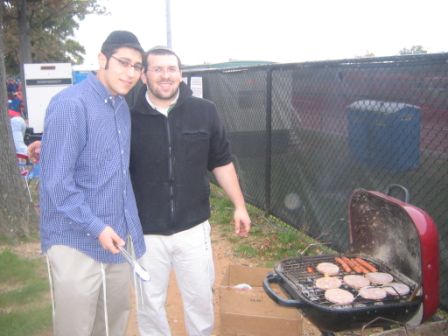
So I procured (from my landlord, actually) a parking permit for the main lot, and went as the lot opened with my Sukkah to make sure that we had a choice spot. We built the Sukkah right there in the lot, brought over grills, and floted blue and white helium balloons so that people would know where to find us. We had a massive, kosher tailgate party in that Sukkah (which has since made Aliyah with me). We sold out of food and black Hillel T-shirts. Hundreds of people came through – Nate helped with the grilling, Alan treated me to a Corona he brought (we didn’t serve beer, but couldn’t tell people that they’re not allowed to bring beer into the parking lot), and we were even visited by the only frum Va Tech fans on the planet. It was probably the most fun I had during the years at UMD, and was definitely a one-of-a-kind kiyum of teshvu ke-ein taduru.

I have some more pictures on my facebook page, and a lot more stored on disk.

10/06/2006

Midwest Meets Middle East: A Tale of Barter and Harsh Realities

Earlier today, I had a major errand in Alon Shvut, followed by some minor ones in Efrat. I hadn’t eaten and it was approaching noon, so I decided to pick up a couple slices at Pizzeria Efrat. By the way, if I ever open an eatery in Efrat (which I won’t), I’ll call it ‘Uchlah D’Efrat’. Daf Yomi learners will get that joke in another few weeks, after they start Beitzah.

Anyhow, I happened to be wearing a burnt-orange Texas Hillel T-shirt which said ‘Hook ‘em Horns’ in Hebrew characters on the reverse. I picked it up 3.5 years ago when the Rebbetzin and I did a Shabbaton down at UT-Austin.

It also just so happens that the proprieter of Pizzeria Efrat, the legendary Mordechai Goodman, is a Houstonian and a UT alum. He’s also, as is very well known, a football fanatic and founder of the American Touch Football League in Israel, and the UT Longhorns are reigning college football champs. If you’ve ever been to that part of the world, college football is an actual religion there. Just ask Austinian blogger Mirty.

Anyhow, so Mordechai sees my shirt and immediately says, I’ll give you the 2 slices, just give me the shirt. I agreed. He then upped the price – 4 slices and a drink – even though my shirt was already halfway off. At this, I asked for a pint of Ben and Jerry’s Ice Cream and 2 slices – forget the other 2 and the drink. Deal. We swapped T-shirts and I took my slices and ice cream. Then we schmoozed about college football for a bit, I told him about my unique tailgate party from last year (which I’ll blog about next week), and we parted company, both very, very happy.

Great story, no?

I called the wife to tell her because she likes hearing these things from me before she reads them on my blog. She mentions that she thinks he’s the same guy who lost a son earlier in the year; an Israeli soldier lost in a parachuting accident.

Goddammit! Why does this ice cream taste so bitter?

10/05/2006

Simchat Yom Tov, Rav Soloveitchik, and Oktoberfest

A well-known idea, articulated by R’ Soloveitchik, is that the Simcha of Yom Tov derives from the existential state of being ‘lifnei Hashem’. True joy, for the Rav, is only in the Presence of God. A quick glace at these results from Google gives an idea of just how widespread this idea of simcha has become. A neighbor of mine just came over to borrow my copy of Harerei Kedem, R’ Michel Shurkin’s cliff-notes on the Rav’s teachings about the Jewish Holidays. He is preparing a shiur on the simcha of Yom Tov. On how true simcha is lifnei Hashem. Walk over to any random guy in the RYBS orbit and ask “what’s the definition of simcha according to R’ Soloveitchik?” BAM. Lifnei Hashem.
There are different variations within this idea, depending who you ask. Lifnei Hashem might be the ultimate simcha, the true simcha, the only simcha, or the state which triggers the obligation of simcha.
Here’s the problem: it’s incorrect. It is VERY possible to have plenty of simcha with or without God, and the Torah is full of references to it. Furthermore, the Rav’s idea is not even borne out by a simple reading of the verses he uses for support. In fact, it flies in the face of a central theme of Sefer Devarim. Allow me to explain.
In the context of the 3 festivals, each time the obligation of pilgrimage is mentioned, God is referred to as ‘Adon’ – Master (as in ‘Yes, Massah’), Magnate, Landowner, Balabos. Our obligation to make the pilgrimage is formulated as the obligation of the vassal toward the magnate. Lest we begin to think that the land is actually ours, that we are entitled to it, we are enjoined to visit the true Owner thrice annually, and to bring tribute along.
This theme recurs throughout Devarim, from beginning to end. The Torah is constantly warning and legislating against growing too self-secure and forgetting God in our success. It is in the very formulation of the mitzvot of Shabbat (in the Devarim version of the Decalogue), the laws governing slavery, the obligation to pray after eating (bentching), the gift of the first fruit (bikkurim), and, as mentioned, the obligation to make pilgrimages.
It shows up in the ‘warning’ sections at the beginning of Devarim (‘kochi ve-otzem yadi being the most well-known and characteristic phrase), in the awful tochecha (which I’ll address shortly), and in Ha’azinu (va-yishman Yeshurun va-yiv’at). In the tochecha, the element of simcha appears specifically. In a well-known but oft-misunderstood section, the Torah warns against forgetting God while being in a state of simcha. If we neglect to serve him while we’re happy, we’ll end up serving our enemies from a state of material want. Simcha without God is indeed possible, but heinous and worthy of punishment.
This brings us back to sukkot, which is our time of joy (zman simchateinu). It is the Jewish ingathering festival (Chag Ha-asif), which is naturally a time of intense joy. Many, many cultures celebrate the annual gathering in the autumn. This is the time when everything that was left out in the field to dry or ferment is brought in. Right at the beginning of the winter is when there’s a lot of food available, so it’s time to party. So the Germans have Oktoberfest, the Americans – Thanksgiving, and we Jews, Sukkot. The Torah was concerned that the natural simcha of this time period would deteriorate into a simcha in which God is absent (and I’ll resist the temptation to take potshots at the way in which Simchat Torah is celebrated in many American congregations); thus, the Torah mandates that our simcha be lifnei Hashem.

10/04/2006

My, My, My

An observation on how Israelis, sometimes, just don’t get it. There are hundreds, if not thousands, of popular websites that begin with the word ‘My’. There’s myspace, my.yahoo, my.msn, myfavoritestore, and the list goes on.

Well, now I’m in Israel, and since I don’t like waiting in lines at banks and post offices, I’m trying to automate any bill that I can. So I just registered to pay my municipal taxes online. The city of Modiin contracts a separate website to do their online collections. The name of the site is MyBills.co.il .

Now hear this, whichever American-wannabe came up with this inane name for a billing website: There’s nothing exciting or personal about bills. 'My' bills are the same damn bills as 'everyone else’s' bills. What’s wrong with bills.co.il? My ‘Space’ is unique and personalized. Municipal taxes are the great equalizer, like death. Nothing special about yours or mine.

End rant.

10/02/2006

Toward a White String

Jeff Woolf laments the fact that religious communities tend to insulate themselves on Yom Kippur, rather than trying to include segments of the population that observe Yom Kippur (which is still the consensus) in an inviting way. He mentions Tzohar, the organization that I work for, specifically our initiative to create welcoming Yom Kippur minyanim. We estimate that we reach about 40,000 to 50,000 people, but that means that there are hundreds of thousands, if not millions, who still could use a 'home' for Yom Kippur. I'm not talking about 'kiruv' or dragging people to shul, kicking and screaming. I'm talking about the average Israeli who fasts and doesn't drive a car on Yom Kippur.
In my
own neighborhood in Modiin, I davened at a new minyan (about a month old - the neighborhood is just now starting to fill up) in a local school. This was not one of Tzohar's 'official' venues, but I saw that a bunch of Tzohar's user-friendly machzorim were available. Many of my non-observant neighbors (chiloni by any definition) attended, especially for Kol Nidre and Ne'ilah (Tzohar also publishes a shorter Machzor with just Ma'ariv and Ne'ilah). It was actually very, very nice. During the highlights, the place was packed, there were tons of kids, and I noticed that many of these non-observant 'newcomers' were singing along to the common tunes. I gave my own machzor to a fellow who looked like he could use it; I knew where we were and what to expect, and he looked like he didn't. I shared with someone for the parts I didn't know by heart.
I 'm happy t
o report that I did not see a single car in motion in my 'mixed religious-secular' neighborhood for the duration of Yom Kippur. Rather, the streets were filled with kids on bikes, roller-skates, scooters, and wagons. I thought it was beautiful (a friend was lamenting all the bikes, until I pointed out that there's really no prohibition against riding a bike on Shabbat).
An
other really nice thing was seeing all of the Sukkot that my neighbors, 'religious' and 'secular', were out building tonight.
All in all,
one of the greatest 'discoveries' I've made sinse arriving in Modi'in is that, contrary to what I've always learned in the religious enclaves, secular Israeli culture is not bankrupt and not devoid of Judaism. There's something very shabbesdik about sitting on a beach with a watermelon that we may be missing out on. I believe that we have something to offer by making out shuls more inviting; but we must be willing to accept certain invitations as well.
Tz
ohar is truly doing wonderful work in this regard, not just by generating the opportunities for encounters, but by trying to effect a sea change in the entire relationship between these segments of the population, and beginning with the community Rabbis themselves. They can go as far as their current funding will take them, but to go where they envision going, we're talking about a budget that is simply a different order of magnitude. Hint, hint.
R' Dr. Jeff c
oncludes his post with the following:
I blame myself, and those like me, who have the tools to communicate and teach, but spend their Yamim Nora'im in religious enclaves. Bli Neder, I intend to find a way to do Teshuvah for that. I urge others to do the same.
It's for this very reason that we chose to live in a city where the random, neigborly encounters offer opportunities to 'communicate and teach' - and, I'd add, to learn. As wonderful as Efrat and Gush Etzion are (I use those examples because I know that I have readers there), and they are truly wonderful, they do not provide those opportunities for chance encounters that cosmopolitan cities provide.
Perhaps it's time f
or the Religious Zionist communities to 're-engage' the urban centers (which are not just composed of oligarchs and Ha'aretz reporters) with all of the confidence and strength that it has accumulated over the past 40 years of incubation on the hilltops (see my series on R' Shimon b. Yochai for more perspective on this phenomenon).
Then maybe we'll begin t
o see some white in that string.

A Very Bizarre Yom Kippur Dream

I rarely remember my own dreams, and they’re usually not much to report, but I had one on Yom Kippur night which was truly strange, and I think I know what it means. Here’s what happened.

In restless dreams I woke up to the sounds of marauders breaking in to my home through the roof on Yom Kippur. I run to the bathroom door, from where they would gain entry to the rest of my house, and try to prevent them from doing so. I scream for my wife to get the kids out of harm’s way and to call the police. The marauders are not people. They are a teeming black amorphous something.

My the time the police arrive, I’ve been killed; beaten to an unrecognizable bloody pulp. The police officer looks around and kind of nonchalantly says there’s nothing he can do. It’s clear he knows more, that this was perpetrated by an evil that he will not confront, or even that he has a deal with to let it run its course without trying to stop it.

So what does it mean? Certain aspects art clear. Having just moved into a new home in a new country, there are certain natural anxieties about protecting one’s family from many an unnamed danger. The fact that I’ve yet to padlock the roof access adds a bit to that anxiety.

The rest of it is Yom Kippur imagery, specifically pertaining to the ritual of the se’ir ha-mishtale’ach, the scapegoat. According to Nachmanides, the idea of this ritual is to ‘throw a bone’ to an evil demigod called Azazel. The goat that was sacrificed was thrown from a cliff; the Mishna records that the goat would be utterly destroyed before it was even halfway down the cliff.

It seems that my own anxieties have transposed themselves onto this scapegoat imagery, with myself as the scapegoat. I fear that I have ‘sacrificed’ myself – career, money, peace-of-mind – for the sake of my family. The ‘unnamed evil’ somehow has an unspoken agreement with the powers that be here in Israel. There will always be a few who are chewed up and spit out.

I hope that these fears remain just fears. Maybe my dreams will be more pleasant next Yom Kippur.

10/01/2006

One Blogger’s Confessional

On the sins that we committed before You out of apathy
And on the sins that we committed before You out of anger
On the sins that we committed before You by bullying
And on the sins that we committed before You by bashing
On the sins that we committed before You out of condescension
And on the sins that we committed before You out of curiosity
On the sins that we committed before You out of doubt
And on the sins that we committed before You out of dogma
On the sins that we committed before You environmentally
And on the sins that we committed before You emphatically
On the sins that we committed before You out of fantasy
And on the sins that we committed before You out of fear
On the sins that we committed before You out of greed
And on the sins that we committed before You through others’ gullibility
On the sins that we committed before You hungrily
And on the sins that we committed before You hurriedly
On the sins that we committed before You out of ignorance
And on the sins that we committed before You out of inhumanity
On the sins that we committed before You joyously
And on the sins that we committed before You jadedly
On the sins that we committed before You by not acting kindly
And on the sins that we committed before You for the sake of kinship
On the sins that we committed before You out of laziness
And on the sins that we committed before You out of lust
On the sins that we committed before You monetarily
And on the sins that we committed before You by mocking
On the sins that we committed before You through narcissism
And on the sins that we committed before You for the sake of nonsense
On the sins that we committed before You through ostentation
And on the sins that we committed before You through opportunism
On the sins that we committed before You philosophically
And on the sins that we committed before You without patience
On the sins that we committed before You out of quietism
And on the sins that we committed before You through phony quaking
On the sins that we committed before You through ridicule
And on the sins that we committed before You through racism
On the sins that we committed before You stubbornly
And on the sins that we committed before You through speech
On the sins that we committed before You through touch
And on the sins that we committed before You through taste
On the sins that we committed before You unabashedly
And on the sins that we committed before You for the sake of unity
On the sins that we committed before You vicariously
And on the sins that we committed before You viciously
On the sins that we committed before You wastefully
And on the sins that we committed before You willfully
On the sins that we committed before You out of xenophobia
And on the sins that we committed before You that are X-rated
On the sins that we committed before You out of youthful indiscretion
And on the sins that we committed before You by yelling
On the sins that we committed before You out of zeal
And on the sins that we committed before You with zest

For all of these, O Clement God, Grant us Clemency, Forgive us, Excuse us