A long time ago, I wrote a post (twice actually; the first one was erased) entitled On Chumra. In it. toward the end, I addressed the original chumra of the Aseret Yemei Teshuva - eating chullin al taharat ha-kodesh, 'plain' unsanctified food in a state of ritual purity. It goes without saying that this was an androcentric chumra, as women weren't always capable of eating chullin be-tahara, but I digress. The point is (see the Maharsha on the Rabbi Safra story at the end of Makkot- if I get a chance, I'll post it in full) that this behavior wasn't simply a supererogatory act, but the product of a completely different way of looking at the world; one in which there's noi room for 'chullin'. When one sees God in every part of creation, then even the mundane realm of unsanctified food betrays God's Presence, and one must act accordingly. Even if one does not live in that state of consciousness year-round, we hope that during the 10 days of repentance, God is 'close' (kir'uhu behyoto karov) on the brain a bit more, and we are forced to evaluate the most minor of our actions by His Light (ori - is Rosh Hashana, ve-hamevin yavin, ve-acamo"l).
The impulse toward chumra during the 10 Days of Repentance must be seen in this regard. It's not about trying to make up for lost time, or about living according to some ideal for a temporary period, definitely not about trying to convince ourselves that this is the 'real' us, and most certainly not about trying to dupe ourselves, our firends or God. We're not that stupid, especially God.
The beloved Yerushalmi that calls the one who performs uncommanded a hedyot is making exactly this point. A hedyot is someone who is unspecial, regular, average. Behaving as though you live within a particular state of consciuousness without actually being there only calls attention to your mediocrity and misplaced righteousness. It's like a civilian Kohen dressing in the High Priest's garb; who do you think you're fooling, idiot?
May we be inspired to truly attain a more Godly worldview, to look at the world with God-colored glasses, as my friend Steg says, and allow that to be reflected in our behavior without contrived temporary norms.
Gmar Chatima Tova.
9/29/2006


9/28/2006
Parnassah from the Sitra Achra
We’ve all heard of the Gemara Beitzah 16a that man’s livelihood for the upcoming year is determined on Rosh Hashana. Many of us have also heard explanations of fabulous wealth as being money that came from ‘impure sources’, or the ‘sitra achara’, etc. See here for a rather mainstream example.
I think there’s something to this, and one need not resort to explanations like ‘medical bills’ to prove how got will ‘balance everything out’. I also don’t really believe up in Heaven there’s a ‘good’ ATM and an ‘evil’ ATM. In fact, I tend not to recognize the ‘sitra achra’ as an independent evil, but as the result of potential good which is not balanced by other potential goods.
As my last few posts have reflected, the judgment of Rosh Hashana stems from a comparison of what we ARE to what we OUGHT TO BE. We look at ourselves, as it were, from God’s perspective, and as part of a total picture. Part of that is a re-evaluation of priorities in life.
We all agree that there our lives are governed by certain cardinal values: family, livelihood, ethical behavior, personal growth, etc. If all is in proper balance, then livelihood ‘knows its place’ and will be determined, and somewhat limited, by its relative importance. One can take a job which pays less, but which allows one to be home more, and vice versa. If all is in harmony, then indeed, one’s livelihood is determined on RH, when this evaluation is made.
However, one may become driven toward imbalance. One may neglect all other concerns and pursue livelihood at the expense of all else. Sure, it’ll get him more money, but the price will be paid elsewhere – not that ch”v he’ll have extra medical bills or something, but in one of the other important areas of life, be it family, ethics, or personal growth. Unfortunately, the old adage that ‘cheaters never prosper’ is simply untrue. Cheaters prosper. But is that prosperity worth the price?
I think there’s something to this, and one need not resort to explanations like ‘medical bills’ to prove how got will ‘balance everything out’. I also don’t really believe up in Heaven there’s a ‘good’ ATM and an ‘evil’ ATM. In fact, I tend not to recognize the ‘sitra achra’ as an independent evil, but as the result of potential good which is not balanced by other potential goods.
As my last few posts have reflected, the judgment of Rosh Hashana stems from a comparison of what we ARE to what we OUGHT TO BE. We look at ourselves, as it were, from God’s perspective, and as part of a total picture. Part of that is a re-evaluation of priorities in life.
We all agree that there our lives are governed by certain cardinal values: family, livelihood, ethical behavior, personal growth, etc. If all is in proper balance, then livelihood ‘knows its place’ and will be determined, and somewhat limited, by its relative importance. One can take a job which pays less, but which allows one to be home more, and vice versa. If all is in harmony, then indeed, one’s livelihood is determined on RH, when this evaluation is made.
However, one may become driven toward imbalance. One may neglect all other concerns and pursue livelihood at the expense of all else. Sure, it’ll get him more money, but the price will be paid elsewhere – not that ch”v he’ll have extra medical bills or something, but in one of the other important areas of life, be it family, ethics, or personal growth. Unfortunately, the old adage that ‘cheaters never prosper’ is simply untrue. Cheaters prosper. But is that prosperity worth the price?
9/26/2006
The Torah’s Appetizers
The following passage appears in Avot 3:18:
[While I was writing this, I came across this piece by one Jonathan Baker which pretty much says what I’m about to say. I wonder if this Jonathan Baker is the same as ThanBook.]
Kinim is the area of halakha which discusses what happens when sacrifices get mixed up with each other. The final Mishna in Kinim is the single most difficult Mishna in all of Shas (the first Mishna in Yevamot doesn’t even touch its bootstraps). It inspired a mathematical commentary by Prf. Moshe Koppel. It’s hard core stuff. Pitchei Niddah, while not quite as complicated, requires a pretty decent working knowledge of arithmetic and the calendrical system, which form the bulk of the content of these halakhot.
These two areas of Halakha require a working knowledge of ‘outside’ = non-Halakhic disciplines. Nevertheless, studying them is studying halakha – they are part of the Halakhic corpus. Mathematics and astronomy are, however, prerequisites – what the Mishna calls ‘appetizers’ – for these laws. If the gematriyot in question are numerologies, then we’re talking about cutesy things which can pepper Torah discussions. An appetizer is a much more serious part of the meal.
This also explains the two groupings – 2 areas of Halakha which rely heavily on non-Halakhic knowledge are nevertheless gufei halakhot, whereas the disciplines that must be mastered before the halakhot are ‘appetizers’ – part and parcel of the meal, necessary to get to the main course in the appropriate state of hunger, but still not the main show. This Mishna is thus an elegant paradigm for the relationship between Torah and Madda.
The above translation is mine. You may notice a few peculiarities in my translation. Namely, that I translate gematriyot as ‘mathematics’ (though ‘geometry’ would be more accurate) and not as numerology, and that I translate parpera’ot as ‘appetizers’ (as evidenced by the Mishna in Pesachim 10:2). These peculiarities give a totally different picture of what the Mishna is talking about.
משנה מסכת אבות פרק ג משנה יח
רבי אליעזר בן חסמא אומר קינין ופתחי נדה הן הן גופי הלכות תקופות וגמטריאות פרפראות לחכמה:
R’ Eliezer b. Chisma says: nests and menstrual onsets are the very corpus of halakhot. Astronomy and mathematics are appetizers for Torah.
[While I was writing this, I came across this piece by one Jonathan Baker which pretty much says what I’m about to say. I wonder if this Jonathan Baker is the same as ThanBook.]
Kinim is the area of halakha which discusses what happens when sacrifices get mixed up with each other. The final Mishna in Kinim is the single most difficult Mishna in all of Shas (the first Mishna in Yevamot doesn’t even touch its bootstraps). It inspired a mathematical commentary by Prf. Moshe Koppel. It’s hard core stuff. Pitchei Niddah, while not quite as complicated, requires a pretty decent working knowledge of arithmetic and the calendrical system, which form the bulk of the content of these halakhot.
These two areas of Halakha require a working knowledge of ‘outside’ = non-Halakhic disciplines. Nevertheless, studying them is studying halakha – they are part of the Halakhic corpus. Mathematics and astronomy are, however, prerequisites – what the Mishna calls ‘appetizers’ – for these laws. If the gematriyot in question are numerologies, then we’re talking about cutesy things which can pepper Torah discussions. An appetizer is a much more serious part of the meal.
This also explains the two groupings – 2 areas of Halakha which rely heavily on non-Halakhic knowledge are nevertheless gufei halakhot, whereas the disciplines that must be mastered before the halakhot are ‘appetizers’ – part and parcel of the meal, necessary to get to the main course in the appropriate state of hunger, but still not the main show. This Mishna is thus an elegant paradigm for the relationship between Torah and Madda.
Colbert on ASY"T
This is funny as all heck.
I hope that all of my readers are mochel me if I've wronged them this year (or any other).
I hope that all of my readers are mochel me if I've wronged them this year (or any other).
Avoiding Nuts on Rosh Hashana – a New Theory (which is Humorous, but Not Funny)
This is one truly out-of-the-box idea that can only come from the gnarled mind of a Rabbi with ADD. It grew out of an ongoing conversation that I’ve been having with Josh about these customs. There are certain obvious clues that something strange is afoot here, beginning with the fact that egoz is NOT be-gematria cheyt, and ending with the fact that there aren’t really many customs out there in which we avoid certain objects or practices because of their numerical value.
First, a brief word about magic. A ‘magical’ worldview (nothing to do with witches or Harry Potter) is one in which causality is not scientific (see here for a fuller definition). There are any number of specific magical laws or doctrines, but the basic thinking, that there’s some type of causal nexus between objects that are similar in some sense but physically independent, pervaded all human rational discourse up until the Enlightenment.
The famous doctrine of Ma’aseh Avot Siman Le-banim, as introduced by the Ramban in Bereishit 12:6, is a classic example of ‘sympathetic’ magical thinking. As support, Ramban invokes effigies and other practices that we would call ‘voodoo’ in support of this doctrine of ‘Ma’aseh Avot’. It’s important to realize that this was commonly accepted rational discourse in the Ramban’s day, and even much later on.
The practice of Simana Milta is a product of the same thinking. In it, the similarity between objects lies in the similarity of their names. As opposed to other systems, in which similarity was determined by, for example, shape (as propounded in the Doctrine of Signatures). Thus, nominal similarities become causal relationships, and by eating things whose names are auspicious, one can cause good things to happen during the year. Thus, the Gemara states that ‘simana milta’ – i.e., ‘these omens are real’, they work.
This brings us to the egoz. An egoz is not just any old nut, but a particular type of nut, in all likelihood a walnut (indeed, R’ Moshe Ha-Darshan, Josh tells me, reports that an egoz has 4 chambers). As has been mentioned here and elsewhere, there are 2 reasons given for avoiding egozim on Rosh Hashana:
The Roman physician Galen, based on the Doctrine of Signatures (see above), writes that the walnut is good ‘brain food’ – the shell is shaped like the human skull, and the nut is shaped like the brain. It’s good for the brain. We will return to this, but suffice it to say that the brain might not be the organ that we’re trying to bolster on Rosh Hashana, which is the anniversary of Adam’s Primordial Sin, which was a sin of da’at.
In pre-modern medicine, there were deemed to be four basic personality types, based on the balance of the four humors – blood, phlegm, black bile, and yellow bile. Each type had certain characteristics, was enjoined to refrain from certain foods and gravitate toward others, and was assumed to have a particular organ that was dominant.
An excess of phlegm rendered one phlegmatic. A phlegmatic personality was characterized by rationality, coldness, logical reasoning, curiosity, and skepticism. The dominant organ is the brain. I suggest that the ‘excess of phlegm’ that was caused by the brain-like egoz had nothing to do with making singing or blowing the shofar difficult, but with an imbalance toward hyper-rationalism.
So why is hyper-rationalism to be avoided on Rosh Hashana? Because it was associated with the Fall of Man. Since the minhag is an early Ashkenazic one, it could have originated a particularly anti-rationalist circle (like the Chasidei Ashkenaz) or culture (like 14-17th Century Ashkenaz). It could have also been seen as an impediment to prayerfulness, as the phlegmatic is less agitated than any of the personality types. This would have been the original reason for the minhag – to prevent the negative effects of excess phlegm (which have nothing to do with breathing passages) on the day that we are most sensitive to Man’s Original Sin of having eaten from the Tree of Knowledge, at the instigation of the snake, the wiliest of creatures.
Thus, to make the connection between walnuts and sin stronger, someone came up with a mnemonic gematria – which, if you have a good shoehorn, works – to connect the two.
There’s one other piece that’s missing to this puzzle: a source that states that the fruit that Adam ate was an egoz.
First, a brief word about magic. A ‘magical’ worldview (nothing to do with witches or Harry Potter) is one in which causality is not scientific (see here for a fuller definition). There are any number of specific magical laws or doctrines, but the basic thinking, that there’s some type of causal nexus between objects that are similar in some sense but physically independent, pervaded all human rational discourse up until the Enlightenment.
The famous doctrine of Ma’aseh Avot Siman Le-banim, as introduced by the Ramban in Bereishit 12:6, is a classic example of ‘sympathetic’ magical thinking. As support, Ramban invokes effigies and other practices that we would call ‘voodoo’ in support of this doctrine of ‘Ma’aseh Avot’. It’s important to realize that this was commonly accepted rational discourse in the Ramban’s day, and even much later on.
The practice of Simana Milta is a product of the same thinking. In it, the similarity between objects lies in the similarity of their names. As opposed to other systems, in which similarity was determined by, for example, shape (as propounded in the Doctrine of Signatures). Thus, nominal similarities become causal relationships, and by eating things whose names are auspicious, one can cause good things to happen during the year. Thus, the Gemara states that ‘simana milta’ – i.e., ‘these omens are real’, they work.
This brings us to the egoz. An egoz is not just any old nut, but a particular type of nut, in all likelihood a walnut (indeed, R’ Moshe Ha-Darshan, Josh tells me, reports that an egoz has 4 chambers). As has been mentioned here and elsewhere, there are 2 reasons given for avoiding egozim on Rosh Hashana:
- It has the numerical value of cheyt
- It increases phlegm
The Roman physician Galen, based on the Doctrine of Signatures (see above), writes that the walnut is good ‘brain food’ – the shell is shaped like the human skull, and the nut is shaped like the brain. It’s good for the brain. We will return to this, but suffice it to say that the brain might not be the organ that we’re trying to bolster on Rosh Hashana, which is the anniversary of Adam’s Primordial Sin, which was a sin of da’at.
In pre-modern medicine, there were deemed to be four basic personality types, based on the balance of the four humors – blood, phlegm, black bile, and yellow bile. Each type had certain characteristics, was enjoined to refrain from certain foods and gravitate toward others, and was assumed to have a particular organ that was dominant.
An excess of phlegm rendered one phlegmatic. A phlegmatic personality was characterized by rationality, coldness, logical reasoning, curiosity, and skepticism. The dominant organ is the brain. I suggest that the ‘excess of phlegm’ that was caused by the brain-like egoz had nothing to do with making singing or blowing the shofar difficult, but with an imbalance toward hyper-rationalism.
So why is hyper-rationalism to be avoided on Rosh Hashana? Because it was associated with the Fall of Man. Since the minhag is an early Ashkenazic one, it could have originated a particularly anti-rationalist circle (like the Chasidei Ashkenaz) or culture (like 14-17th Century Ashkenaz). It could have also been seen as an impediment to prayerfulness, as the phlegmatic is less agitated than any of the personality types. This would have been the original reason for the minhag – to prevent the negative effects of excess phlegm (which have nothing to do with breathing passages) on the day that we are most sensitive to Man’s Original Sin of having eaten from the Tree of Knowledge, at the instigation of the snake, the wiliest of creatures.
Thus, to make the connection between walnuts and sin stronger, someone came up with a mnemonic gematria – which, if you have a good shoehorn, works – to connect the two.
There’s one other piece that’s missing to this puzzle: a source that states that the fruit that Adam ate was an egoz.
Rosh Hashana and Pesach (Updated)
(Updated -and updated again!)
The first night of RH has become, along with Pesach and Tu B’Shvat, a seder. I’ve heard people here talk about the Rosh Hashana Seder. It's a real cultural phenomenon, even if you don't hold like the Hagahot Asheri (that Phoebus showed me) that one dips the heap of a sheep in honey (eeeewwwwww!)
UPDATE: If you, like me, can't stand the idea of eating fish heads, you may want to try this - after all, it's simana milta, a symbolic thing:
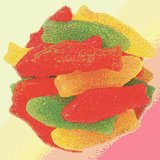
You can even chop off their little jelly heads!!
9/25/2006
BAck in the MSM
No, I’m not such a media hound. Chanan interviewed me almost a year ago, but the article was just published in the Jerusalem Post today.
9/22/2006
Rosh Hashana Entertainment
I went to the mikveh today, as I customarily do every erev RH and erev YK (I’m a two-day-a-year chassid, I guess). Outside this mikveh in Kiryat Sefer were a bunch of yeshiva kids raising money for various yeshivot and kollelim, except that one guy was SELLING POPCORN! I mean, he had one of those big popper machines!
9/21/2006
Losing Sight of the Forest for the Nuts
Josh has a good post on the no-nut minhag on RH. As my father is fond of saying, I believe in the name of the Klausenberger, we would do well to remember that chet also has the same gematria as chet. This flies in the face of the old 'you are what you eat' theory. REfraining from nuts seems a bit, well, nuts, and eating them seems perfectly sane.
In a similar vein, I try, when possible, to daven 'ke-vatikin' on RH, so that the Rebbetzin can go to shul for tekiot and mussaf. Inevitably, it means that I would nap at some point in the afternoon. Aha! But that will mean that my mazal will sleep this year, or that I'll have a sleepy year, or whatever.
Since when did this old wives tale become more important than the old wives themselves?
In a similar vein, I try, when possible, to daven 'ke-vatikin' on RH, so that the Rebbetzin can go to shul for tekiot and mussaf. Inevitably, it means that I would nap at some point in the afternoon. Aha! But that will mean that my mazal will sleep this year, or that I'll have a sleepy year, or whatever.
Since when did this old wives tale become more important than the old wives themselves?
Subscribe to:
Posts (Atom)