10/21/2006

Book Review – Tzir Kissufim: In the Land of Prayer

[This will be cross-posted on the Lookjed educators' discussion forum; the book is available here; if you order it, please enter 'ADDeRabbi' in the comment section of the order.]

Book Review – Tzir Kissufim: In the Land of Prayer

Edited by Daniel Gutenmacher

Translations by Toby Klein Greenwald

The expulsion of the Jews from Spain in 1492 inaugurated a period of unparalleled religious ferment which expressed itself in numerous ways, for better or worse. The Gaza disengagement of 2005, we are starting to see, has similarly inspired a wealth of religious responses, and it remains to be seen what the ultimate effects of it will be. It is safe to assume that the introspection it inspired and the fact that it forced an entire movement – the Religious Zionist movement – to endure the shattering of its dreams will continue to generate creative tension for a very long time.

A particular manifestation of this ferment is the re-invention of an art that had been almost forgotten by the Jews – that of prayer writing. Personal and liturgical compositions are available from every era, but the sheer volume of those written in response to the Hitnatkut qualify as an explosion of prayer-writing. Dozens of Tisha B’av Kinot for the Disengagement have been penned, and several collections of prayers have been published in Hebrew. Daniel Gutenmacher and Toby Klein Greenwald have now made some of these writings available to the English-speaking public in the form of the book Tzir Kissufim: In the Land of Prayer.

The task that the translator and editor set before themselves is a daunting one. Hebrew is the language of Jewish prayer, and the compositions in this collection, though new, are constantly alluding to elements of Hebrew scripture and liturgy. There are terms that have specific meaning within the context of the Israeli experience which are lost in translation. This is in addition to universal challenges of translating poetry, with its ambiguities, double entendres, rhyme, and meter.

I’m sure the translators themselves would agree that these prayers are far less inspiring in English. Therefore, the value of the translation is similar to its value for any translated siddur – to help the reader understand what he’s saying in the original. The translation is up to this task, though it would have greatly benefited from notes which refer to the scriptural and liturgical allusions and explain the poetic devices employed by the writers.

In addition to the translation, the compositions are divided into thematic sections, each section prefaced by an introduction to the theme and a preview of the contents of the section. They also include photography, art, and prose that are linked to the theme being introduced. These introductions are helpful in that they frame the mood of the upcoming prayers, but are sometimes too conspicuous, such as when the introduction to the section is longer than the section itself (Section VII). The topics range from very general (Section III: To Be Enveloped in Divine Light) to specific (Section VIII: Happiness in the Shadow of Pain: Shabbat). The artwork that is interspersed throughout the volume lends another dimension to the feelings that the writers are trying to capture. This visual medium succeeds so well that it makes one wonder why more religious art is not included in siddurim.

The prayers themselves form the centerpiece of the volume. Many of the prayers in the collection deal directly with the Hitnatkut and its aftermath, some more generally with the ‘situation’ in Israel, and a number address universal religious concerns. The writing of Ruchama Shapira consistently alludes to Biblical events (‘Akedah’ – pp.8-13) and verses (‘Bloodshed, Crisis, and Rebirth’ on pp. 24-29 is loaded with Biblical and Rabbinic references), and transposes them onto the very real experience of the Disengagement, in which she was evicted from her home. Ido Levinger’s prayers, on the other hand, tend to address the universal human concerns about faith(104-5), apathy (78-81), and redemption(58-9), though they can easily be read against the backdrop of the events in Israel. These two writers contributed fourteen of the thirty-five prayers in this collection.

In general those writing from direct experience are more gripping than the writing of those whose experience is second hand. The prayers are also at their best when the writers are not straining too hard to be inspirational (or trying to borrow too heavily from Rav Kook’s elevated writing style), but are trying to sincerely chronicle their own conversations with God. Prayerful simplicity, in the tradition of R’ Nachman of Breslov, is the most successful way that these writers convey their raw feelings, without injecting philosophy, politics, or theology. I found the most moving prayer to be the one entitled ‘The Soldier’s Lekha Dodi’ (98-103) penned by a yeshiva student to relive his personal Kabbalat Shabbat while on guard duty, after a particularly difficult week. Toby Klein Greenwald’s ‘Grandmother’s Prayer’(32-3) is another whose simplicity tears at the reader’s heartstrings.

On the whole, the prayers in this collection display a range of literary power and technical quality. For someone in the market for a good poetry collection, there are much better ones out there. The value of this book is in its presentation of contemporary prayers written by living Jews during events that we have all experienced first, second, or third hand. The writers walk amongst us, are us. Thus, as an introduction to the world of Jewish prayer-writing, to help individuals find their voice in prayer, for educators to initiate their students into the world of prayer-composing, with the hopes that they may recover the personal elements of their own prayer and perhaps even compose their own prayers, this slim volume (159 pages) can be a valuable tool.

Notes from the Peanut Gallery

1) Poor Choice of Words
This review was pretty good (Thanks for posting the link, Gil. Maybe you'll link to a review that I'll have up in a few hours.) There's just one line that absolutely must be taken out of that review:
We get a penetrating analysis of the "Rape of Dinah"

2) Takes on Pictures
The following picture inspires Harry to write about the dangers of religious extremism. It inspires me to think about the wonders of cameras that eliminate red-eye:

10/20/2006

First Rashi on Chumash: Do We Understand it Correctly?

Everyone knows the first Rashi on Chumash, right? He begins by quoting R’ Yitzchak in a Medrash, asking why the Torah doesn’t begin with the mitzvah of ‘Ha-chodesh ha-zeh lachem’, about 1/3 the way through Shemot?

Rashi goes on to explain that the purpose of the creation story is to establish God’s ownership over the world, in order to justify our occupation of the land of Israel. God gave it to us. It’s God, so he can give it to whomever he wants and take it away from whomever he wants. At the very least, this is how everyone I’ve ever encountered explains this Rashi, and, at first blush, it would seem to be exactly what Rashi is saying.

However, as I once posted before, and I think bears repeating again and again until this becomes the common understanding of this Rashi. The difference can’t be overstated.

Basically, the key misunderstood line is ‘'le-eit asher yashar be-einav'. It’s commonly understood to mean ‘to whomever he pleases’. In that understanding, God’s will is made to be arbitrary, and if he chooses not to give you prime real estate, that’s just tough luck, because He owns the world and can do with it what he pleases.

However, throughout Chumash and the writings of Chaza”l that which is ‘right in God’s eyes’ is not arbitrary at all. It’s about a system of Godly values, enshrined both in halakhic legislation and in supererogatory practice (lifnim mi-shurat ha-din, which is related to the verse ‘ve-asita yashar ve-hatov be-einei Hashem’), by which we, as people, follow in God’s ways. We will not do what is right and good in our own eyes, as is the common negative refrain of Sefer Shoftim, rather, that which is right and good in God’s eyes.

The implication of God’s creation is not that we must respect God’s ownership of it, but that the incomprehensible motives that God had for creating the world can somehow be called ‘Goodness’ or ‘Kindness’ – Olam Chesed Yibaneh – and the challenge of being human is the challenge of continuing the work that God started but left for us to complete (asher bara Elokim la’asot, et al). This challenge began with Adam, but we see now that it began even before; it was built into creation. It continues through the stories of our Patriarchs, though with the difference that whereas through Abraham the challenge was for all of humanity over all of the world, in the wake of multiple failures God chose one family to achieve those goals in one place, and to serve as the catalyst of universal success. Our Partiarchs, especially Abraham, were guided by that set of Godly values and traits – chessed, tzedek, mishpat – before they were enshrined in the Torah’s legislation. The message – that is made clear in the Netziv’s introduction to Bereishit and as AlanLaz brings in the name of the Netivot Shalom, there’s a basic sense of yashrut which undergirds the Torah, which the Torah seeks to develop and refine, and without which the mitzvot are rendered largely worthless (see the Netziv’s sharp intro if you think that’s an exaggeration). This sense of Yashrut, present in creation itself, it the prerequisite for everything that comes after Parashat Ha-Chodesh. Thus, Bereishit is nicknamed Sefer Ha-Yashar. How can we miss that allision in the first Rashi?

It also means that the covenant that develops throughout Chumash – first between God and Adam, then Noah, Abraham, Isaac, Jacob, etc. until it’s contracted as the Torah with all of Israel – is present in the very act of Creation. The goal of creation was to be able to enact a covenant with a people, whereby they would live according to that which is Yashar be-eini Hashem, and would reciprocally merit to live in the land which is constantly under God’s scrutiny (einei Hashem Elokecha bah me-reishit ha-shana ad acharit ha-shana), and where living according to the Covenant is part and parcel of living in the land (see, e.g., the entire book of Devarim). And according to this Rashi, it’s built into creation.

A final comment relates to the type of ‘Zionism’ that this Rashi promotes. The more common read lends itself to a Zionism of entitlement – it’s ours, not yours, so get out. The other read is much more about Zionism as a challenge, something that we must constantly be striving to live up to. I suspect that it also offers a fundamentally different way to relate to indigenous populations. When one is fvrced to admit a degree of uncertainty about his own deserved-ness of the land, it becomes much easier to tolerate the presence and claims of others (see also what I wrote here and here).

10/18/2006

Come on, Harry

This post by Harry Maryles, and the ensuing comments, really, really bothers me. He writes about a Kallat Torah which apparently took place at HIR this year. He then goes on to rip into this type of innovation. Read it for youself, if you have the stomach.
Here are the issues I have with this kind of reasoning:

1) Simchat Torah is, in Jewish terms, a brand-spanking new holiday. Do you realize that the Mechaber and Remo don't even mention Hakafot? Did you notice that the Mishna Berurah, whose ink, in the grand scheme of things, is barely dry, mentions that there are 'some communities who do 3 hakafot and some who do 7'? Yet you shray chai vekayam about R' Avi Weiss 'twisting' 'millenia old' traditions?

2) Is this really a major issue, Harry? Is the slope really all that slippery? What are you afraid of? BTW - I saw a Kallah Torah at Yakar in Jerusalem 10 years ago. Nothing is innovated in America, don't you know that by now? Sv now that you know this, are you going to draw conclusions and make declarations about the Rosen family and their corner of the orthodox world? or perhaps not since that's not the axe you're looking to grind?

3) In the comments you wrote about this being 'poresh min ha-tzibbur'. I'd like to know if you attended a 2nd-day Chu"l minyan in Eretz Yisrael. If you did, then you can stop criticizing others for being 'poresh' before the magnifying glass is turned back on you.

4) Who made you the judge and jury of what's 'extreme' and what's 'normal'? Are right and left wing defined by your personal comfort zone? And what do you know about the 'practical benefit' of these innovations? Hw d yu knws what his balabatim want?, and whether it's a 'legitimate' critique or mere 'social feminism'? Why must we insist on trying to psychoanalyze anyone who wants to try something muttar but different? Must we always evaluate their motives? Do we apply that standard consistently to anyone, male or female, who is looking for some type of religious expression, bein le-kulah, bein le-chumrah?

5) You may not like the direction of 'Left Wing Modorthodoxy' but there's a big, wide world out there, and most of it is outside your daled amos. For some odd reason, your version of things doesn't resonate with the majority of klal yisrael, and there's been plenty of time to try to work it out. If someone wants to take a different approach, which isn't quite as radical as, say, early chassidus, then watch and listen to see if they've chanced upon something that didn't occur to you.

Name Games

There are a few games that you can play with other people’s names that can be lots of fun. My wife was at the receiving end of this, as her maiden name was very lyrical, almost like ‘Marco Polo’. I had a chavruta who also had such a name.

I recently got an invitation for the KBY dinner which took place on Chol Ha-mo’ed. The alumnus they chose to honor is a fellow named Ofer Unger. That would be a great name for a bookie. Of course, in Hebrew the name doesn’t sound like anything strange. In English, though, it’s like “Hey, what’s the Ofer/Unger on the Mets-Cards Game 6”. It alsv recalls the hilarious takeoff scene from the moie 'Airplane'. It's so much more fun than just snickering at an Israeli named 'Dudu' or the like.

There’s also two versions of the ‘no last name’ game. It starts with a little ditty that can be sung when encountering someone whose last name is also a first name. It is sung to the tune of ‘Frere Jacques’:

Richard Joel

Richard Joel

No last name

No last name

You can call him Richard

You can call him Joel

No last name

No last name

If you can find someone with 3 or more ‘no last names’, it can get really fun. Former Israeli President Yitzchak Ben Zvi is a 3. I’ve encountered a few 4s, but only once have I nailed a 5er:

Ben Zion Meir Chai Uzziel

Ben Zion Meir Chai Uzziel

No last name

No last name

You can call him Ben

You can call him Zion

You can call him Meir

You can call him Chai

You can call him Uzziel

No last name

No last name

See how much fun this can be?

The other version is when you put together a string of ‘no last names’ such that the names in the middle are the prior person’s last name, and the next person’s first name. This can work in Hebrew or English. For example:

Amnon Yitzchak Mordechai Eliyahu Bakshi Doron Sheffer

Or

Malcolm Little Richard Joel Paul Simon Bolivar

Try it. It’s great fun.

Would that Nechama Had a Blog

In the wake of this post, I got an email from veteran educator and LookJed moderator Shalom Berger (who has allowed me to post his comments with full attribution):

Regarding the Yetzer Ha-Ra to teach, I recommend getting hold of "Pirkei Nechama" and reading her letter to Rav Posen (pp. 669-671) where she questions whether she travels the country teaching "le-hagdil Torah U'leha'adira" or because she gets paid, receives compliments, or fights loneliness. She concludes by saying that people are better off not examining too closely why they do things.

Her letters that appear there are a great read - including the one to Nati Helfgot saying that she thinks publishing articles is a waste of time because no one reads them anyway and few people really have anything of value to say. What would she say about blogs?

Shalom

First off, though I haven’t read this letter, the first part of the summary really describes what I was trying to say. I’d only add that if there potential negative consequences to some of the motivations, there should be safeguards in place to make sure that those consequences are avoided. We need not analyze the motivations of our educators, but we DO need to make sure that negative motivations aren’t made manifest in negative behavior.

Regarding the second issue, I have no idea what Nechama would say about blogs. I’d offer, though, that it’s a medium which facilitates, in general, good exchanges of ideas, interactive learning, and peer review. It’s not as static as an article, yet works in a more rigid forum than an open discussion. It has the interactive advantages of chavruta learning, such as peer review and multiple viewpoints. The discussion remains refreshingly honest – if someone says something stupid, it’s generally pointed out to him (or her, but we go easy on the ‘her’s, right guys?). Access to original texts to be commented upon is becoming more and more commonplace.

Granted, the blog must be modeling some kind of real-life social network in order for it to take flight (and I wonder what social reality my blog parallels? Is it a Kiddush? A Shabbos Table?), but eventually becomes a sui generis community. In that sense, learning takes place here as a socio-religious act, in contrast to the classroom or Beit Midrash, where the social factor is much more subdued (or is it?). That’s also why the same topics tend to be constantly rehashed; it’s not about the passing of information. Rather, it’s about the social act of discussion and debate about topics the community finds meaningful.

Ultimately, though, the proof is in the pudding. If people learn seriously through blogs, then it’s a good medium for Talmud Torah. In my estimation, they do, but as communities or societies, and not as students in a classroom. It’s a very ‘Talmudic’ process, in my estimation. R’ Shalom himself is looking to create a blog for the community of educators. The community definitely exists; will this recreate an existing communal interaction in virtual space in a meaningful way, much as their listserv has already done? Will it enhance that, make it more lively, add voices, or give those voices more of an edge? We’ll see.

10/16/2006

Very Random ADD Yontif Post

  • There’s something very disconcerting about driving on the highway to Jerusalem listening to Simon & Garfunkel’s “America”. I’m not counting the cars on the New Jersey turnpike. And everyone on this road might be looking for something, but it ain’t ‘America’.
  • That said, other songs on that album – the Concert at Central Park – have renewed resonance, especially ‘The Boxer’, ‘Bridge Over Troubled Waters’, ‘Homeward Bound’, and ‘Slip Slidin’ Away’. The rendition of ‘Bridge’ on that album sends shivers down my spine.
  • Driving toward the old city, we avoided traffic by taking a shortcut through East Jerusalem. This made the wife nervous. Ruchama picked up on this and asked ‘Where are we going?’ I answered, ‘To see our cousins’. She asked, ‘What’s his name?’ ‘Ahmed’. ‘Does he have children?’ ‘Yes. He has lots and lots of children’. Funny kid.
  • There are three Jews in the news lately who I’d have a hard time not taking a crowbar to if I saw them on the street. This one, this one, and this one. The third is less known in the U.S.A., so I’ll summarize his exploits. Apparently, he has 65 unpaid moving violations, and, in a state of intoxication, ran his SUV straight over a small car containing the Deputy Mayor of Tzfat, his wife, and 2 kids. Three are dead. This [insert expletive of choice] should be lynched by the townsfolk of Tzfat. I just found out that I have a close relative who works for a company that services Mondrowitz’s appliances. I have half a mind to dress in their uniform, go in there, and, um, fix the plumbing, i.e., eliminate the risk to the neighborhood kids. The Monsey chicken man is probably the least heinous of the three.
  • The upside of living near a bunch of soldiers (the development across the street is for army lifers) is that the shul runs like a clock. The turnover between Kiddush and the chassanim on Shabbat/Shemini Atzeret/ Simchat Torah was astounding. The down side is that they apparently like to have large dogs. I don’t like large dogs. Especially when they are not curbed by the owners.
  • Simchas Torah is a Diaspora holiday. It was not invented in Israel, where they had one day of Yom Tov but read the Torah in a triennial cycle (like a primitive Daf Yomi of sorts. That’s why everything could be done over 2 days. In Israel today, you get all of the Simchas Torah customs plus geshem and yizkor all on the same day, plus a Kiddush in the middle. Shul was over 6 hours long. Longer than Rosh Hashana.
  • I like the fact that in yizkor, everyone stays in while the victims of the Holocaust and fallen soldiers are commemorated.

10/12/2006

New Shul, Old Shul


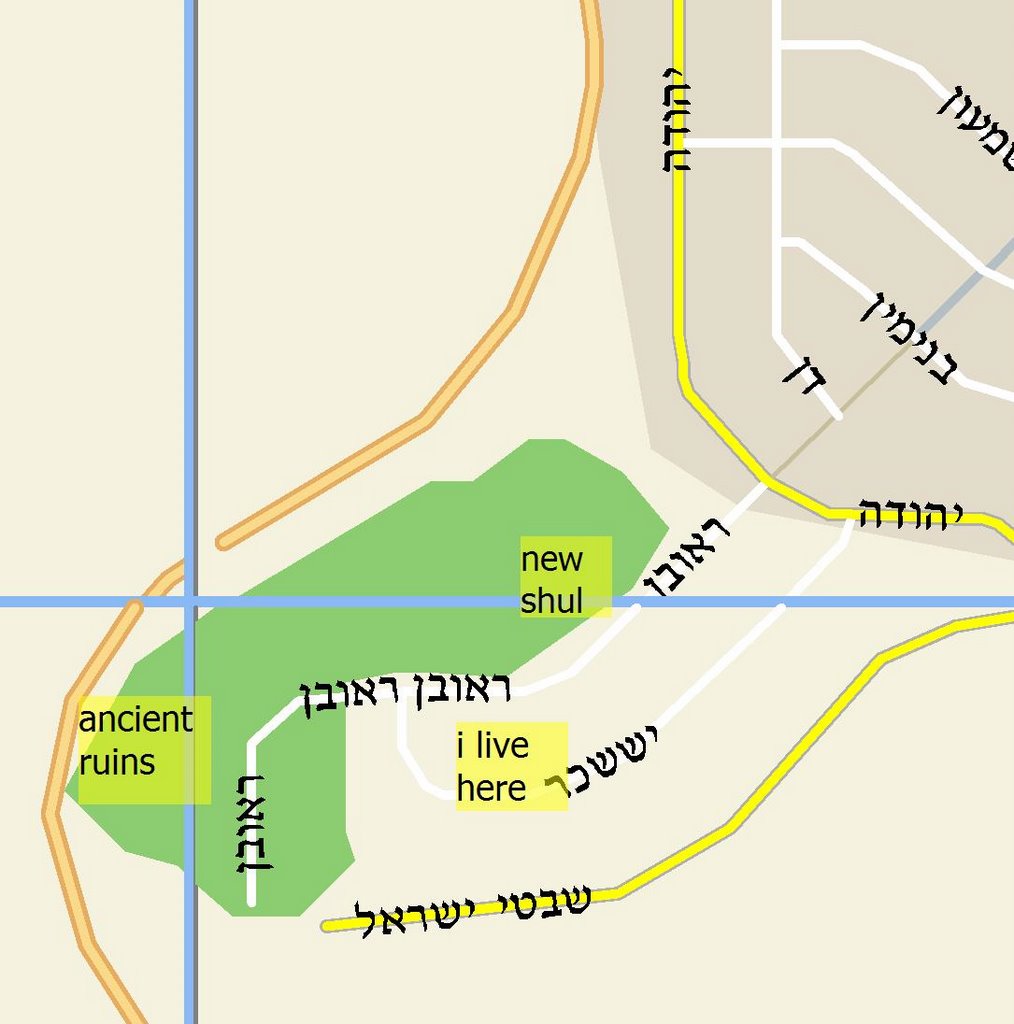
A new shul opened about a block away from my new home just about a month ago. They were expecting 40 people to show up the first Friday night, and about 120 did. It’s been growing ever since, as word spreads and neighborhood continues to be populated at a rapid pace. I’ve gotten involved somewhat; in addition to becoming a member and helping out when I can, I’ve taken on a few ‘functional’ roles – speaking, leading the davening, etc.
It’s very exciting to be part of something so new.

At the end of my street and through some thicket (there’s a longer path around as well), an ancient Jewish settlement – dating back to possibly the 2nd Century BCE, but at latest the 1st Century CE, including a shul and mikva’ot was discovered while preparing to pave a road in 2001. It is one of two sites that are considered likely locations of the ancient Hasmonean city of Modiin.
The shul has been fenced off by the Antiquities Authority, but the rest of it is open, and I’ve taken to exploring it with friends and family, and even by myself. I first went down the 2nd night of Rosh Hashana and davened Ma’ariv there in the solitude. It was pretty intense. Since, I’ve been back at least 3 times, and am planning on going again today. I went with the proprietor of the Dancing Camel microbrewery, who also organizes an occasional Carlebach minyan, to check it out as a potential venue. That’s be pretty intense, too.
I also went down with my 2 older kids, and occasional commenter ‘Tel Talpiot’ and his kids. We really got a chance to explore, going down the seven steps into the ancient mikvah’s basin, getting a great view of the shul from it’s northern end, finding some potsherds, and exploring the densely-packed town. Alas, we could not find the remains of any popcorn stand near the mikvah.

Ultimately, I’d love to see the site integrated into some type of Jewish cultural center, blending the ancient with the contemporary, where today’s Jews can find God and meaning just as those from millennia ago. I know there are others who share this dream, and I intend to seek them out and make it a reality (so that this doesn’t happen).
It’s very exciting to be part of something so ancient.

10/11/2006

Spinning the Monsey Chicken Scandal

The big winner in this whole thing is…. The OU.

This establishment wasn’t under the OU because, basically, OU mashgichim don’t have long enough beards. The thing about the OU is that they’re pro. They’re not like these mamma and tatta chassidishe kashrus organizations that look very frum but can’t possibly have the clout and degree of institutional knowledge that the OU has. I’ve heard, on very good authority, that a bunch of these little hashgacha agencies called up the OU in the wake of the scandal in order to know how to protect themselves from this type of fraud. The fact it’s almost impossible for this to happen to an OU establishment makes them look really good.

It also makes you wonder about the degree of contributory negligence on the part of the community. When one chooses one kashrus organization over another because of some sort of cultural fealty (i.e., it’s under a heimische hashgacha) there seems to be a greater acceptance of responsibility – you’re not relying on others’ judgment, you’re, in a sence, making your own decision.

An expert OU mashgiach once pointed out that it’s possible to be at an establishment 24/7 and not be a temidi, and it’s possible to be somewhere once every few months and be temidi. It’s about knowing what to look for and where to look – auditing the books will yield more information than examining the chickens.

And a final observation: Why do communities get thrown into a tizzy when it turns out they’ve been eating trayf, but don’t seem quite as bothered – on the communal level – when it turns out they’ve been employing a sexual predator in their schools?