A friend and commenter has informed me of another Kinnah related to last year’s pinui. His kinnah is more complex and thorough, and much longer, and relates to each of the uprooted settlements individually. I tried to avoid focusing on territorial aspects, but it’s impossible to ignore that dimension of the tragedy.
May this be the last event that finds expression through the medium of Kinnot.
7/31/2006


7/30/2006
ציון במשפט תפדה, ושביה בצדקה
The verse which forms the title of this post, the final one in the first chapter of Isaiah and of Haftarat Chazon, is well-known and very resonant. Loosely translated, it means “Zion will be redeemed through justice, and her returnees through righteousness”. I just learned over Shabbat that the original Jewish fraternity, Zeta Beta Tau or ZBT took its letters from the acrostic formed by the first three words of the verse, which emphasizes their commitment to social justice, and the fact that it originated as a Zionist movement.
This verse is also the locus of one of my grandfather’s favorite gematriyot. He was a great fan of word and number games, including gematriyot, acrostics, and riddles. This one in particular, which my Zaidy probably told me during my visit on Erev Shabbat Chazon is particularly fascinating.
Most readers will probably imagine that I’m not the biggest gematriya fan. The reasons for this are too numerous to start listing. Even I, however, cannot help but being impressed by this gematriya. It is truly impressive. I must have recalculated it 15 times in my life to make sure it’s really correct, and, by golly, it is. The size of the numbers and the way that it fits with a basic understanding of the difference between Torat Eretz Yisrael and Torat Bavel is simply astounding. Here it is:
This verse is also the locus of one of my grandfather’s favorite gematriyot. He was a great fan of word and number games, including gematriyot, acrostics, and riddles. This one in particular, which my Zaidy probably told me during my visit on Erev Shabbat Chazon is particularly fascinating.
Most readers will probably imagine that I’m not the biggest gematriya fan. The reasons for this are too numerous to start listing. Even I, however, cannot help but being impressed by this gematriya. It is truly impressive. I must have recalculated it 15 times in my life to make sure it’s really correct, and, by golly, it is. The size of the numbers and the way that it fits with a basic understanding of the difference between Torat Eretz Yisrael and Torat Bavel is simply astounding. Here it is:
ציון במשפט תפדה = 1076 = תלמוד ירושלמי
ושביה בצדקה = 524 = תלמוד בבלי
ושביה בצדקה = 524 = תלמוד בבלי
7/28/2006
My Bubby’s Favorite Friday
I was fortunate to have grown up within walking distance from all four of my grandparents. While we visited all of them regularly, my paternal grandmother, aleha ha-shalom, provided a special incentive for us to visit: she was an awesome cook. She lived on the second floor of an apartment building, and we could tell what she was making as soon as we entered the lobby. It was the best-smelling apartment building in the world.
At some point around my bar mitzvah, I discovered that my father's Friday visits to her after work were timed so that he could sample the food she had cooked for Shabbat, and soon I was in the habit of visiting each Friday as well. My younger siblings eventually caught on as well, at which point the portions began to get smaller.
At some point, I think my Bubby became nervous that we were coming for the food, not for her. Sure, we’d chat with her, but it was always Friday afternoon, when we knew we'd be able to sample that delicious Shabbat food. So we made sure to always visit Bubby on the Friday before Tisha Be-Av, Erev Shabbat Chazon. This was the one Friday of the year that we’d be unable to sample the fleishig food. The apartment smelled as tantalizing as ever, mocking our dairy-fueled doldrums. And this is what reassured my Bubby that our weekly visits were really primarily to see her, and that the food was simply a really, really good incentive.
At some point around my bar mitzvah, I discovered that my father's Friday visits to her after work were timed so that he could sample the food she had cooked for Shabbat, and soon I was in the habit of visiting each Friday as well. My younger siblings eventually caught on as well, at which point the portions began to get smaller.
At some point, I think my Bubby became nervous that we were coming for the food, not for her. Sure, we’d chat with her, but it was always Friday afternoon, when we knew we'd be able to sample that delicious Shabbat food. So we made sure to always visit Bubby on the Friday before Tisha Be-Av, Erev Shabbat Chazon. This was the one Friday of the year that we’d be unable to sample the fleishig food. The apartment smelled as tantalizing as ever, mocking our dairy-fueled doldrums. And this is what reassured my Bubby that our weekly visits were really primarily to see her, and that the food was simply a really, really good incentive.
7/27/2006
Blogcasting
When Greg and I get together, we'll usually wind up having an interesting conversation about something or another. At some point, he had the idea of recording those conversations and podcasting them. I must admit that it's not easy to carry on a 'normal' conversation with the mic recording us. I definitely didn't have my 'A' game. Thus, the result is somewhat contrived, and of suspect quality, but still pretty enjoyable. Of course, I'm biased.
This may be the start of something interesting, though. It's like a multivocal, audio blog post.
Anyhow, here's the result. At this point, the concept is more interesting than the content, but that will improve.
This may be the start of something interesting, though. It's like a multivocal, audio blog post.
Anyhow, here's the result. At this point, the concept is more interesting than the content, but that will improve.
In Defense of New Kinot
As Menachem recently wrote, and as Joel commented here, the Rav, zt”l, didn’t like the idea of ‘new’ Kinnot. Given that I composed one, it would seem fairly obvious that I don’t toe that line, though I was not aware of the Rav’s position when I wrote it. I’d like to submit an explanation as to why I don’t follow the Rav on this.
First of all, it is quite clear that the Rav’s position is not the consensus. Other gedolim, notably R’ Shimon Schwab and the Klausenberger Rebbe composed Kinot for the Holocaust. It has become extremely widespread to recite these Kinot and/or other Holocaust-themed Kinot. In general, the standard kinot earned their status as classics. These were selected from amongst many that were composed in Medieval and Early Modern times (R’ Elazar Ha-Kalir lived during the Geonic Era; he was not a Tanna). Thus, it’s very hard for anyone today to outdo what was done then, but it’s not impossible. Bialik and Agnon are prime examples of modern writers whose prose and poetry could rival the ancients in terms of literary complexity and depth, as well as aesthetic value. I would rather not discuss the Rav’s historical claims regarding the composers of the standard Kinot, ve-hamaven yavin.
‘New’ Kinot are often easier to understand, but that doesn’t mean much. Limericks are easier to understand than sonnets. There’s definitely a trade-off, as with pretty much everything else in life, between complexity and intelligibility (The Rav actually has an awesome exposition of a Gemara in Mo’ed Katan on this theme; it appears as the introduction to his eulogy for R’ Chaim Ozer Grodzensky). It’s not surprising that the Rav stood completely in favor of preserving complexity and not conceding an inch to something less that might resonate with the contemporary crowd. I am in good company with those who don’t stand with the Rav on this issue. Perhaps I might be part of what the Rav would characterize as Korach’s ‘Common Sense Rebellion’. I’ll have to live with that.
Another issue, far more personal, pertains not to the question of reciting new Kinot, but to the question of writing them. Although the Rav laid the foundation for finding religious value in individual creativity, his application was almost exclusively to Talmud Torah. When it came to the liturgy, his sensibilities were much more conservative. Nevertheless, having now undergone the experience of writing a Kinah, I submit that it is a much more effective means of relating to the themes of the day on a very personal level. If reciting the standard Kinot or learning about select ones – a la Rabbi Weinreb or Rabbi J.J. Schachter – works for you, great. Both are excellent Kinot speakers (Ouch! Awful Rabbinic pun!). But if you can find the opportunity to record your own feelings and formulate them through a literary medium, I’d recommend it. It’s a wholly different level of engagement in the mourning process. And if it’s good enough, it may have posterity.
First of all, it is quite clear that the Rav’s position is not the consensus. Other gedolim, notably R’ Shimon Schwab and the Klausenberger Rebbe composed Kinot for the Holocaust. It has become extremely widespread to recite these Kinot and/or other Holocaust-themed Kinot. In general, the standard kinot earned their status as classics. These were selected from amongst many that were composed in Medieval and Early Modern times (R’ Elazar Ha-Kalir lived during the Geonic Era; he was not a Tanna). Thus, it’s very hard for anyone today to outdo what was done then, but it’s not impossible. Bialik and Agnon are prime examples of modern writers whose prose and poetry could rival the ancients in terms of literary complexity and depth, as well as aesthetic value. I would rather not discuss the Rav’s historical claims regarding the composers of the standard Kinot, ve-hamaven yavin.
‘New’ Kinot are often easier to understand, but that doesn’t mean much. Limericks are easier to understand than sonnets. There’s definitely a trade-off, as with pretty much everything else in life, between complexity and intelligibility (The Rav actually has an awesome exposition of a Gemara in Mo’ed Katan on this theme; it appears as the introduction to his eulogy for R’ Chaim Ozer Grodzensky). It’s not surprising that the Rav stood completely in favor of preserving complexity and not conceding an inch to something less that might resonate with the contemporary crowd. I am in good company with those who don’t stand with the Rav on this issue. Perhaps I might be part of what the Rav would characterize as Korach’s ‘Common Sense Rebellion’. I’ll have to live with that.
Another issue, far more personal, pertains not to the question of reciting new Kinot, but to the question of writing them. Although the Rav laid the foundation for finding religious value in individual creativity, his application was almost exclusively to Talmud Torah. When it came to the liturgy, his sensibilities were much more conservative. Nevertheless, having now undergone the experience of writing a Kinah, I submit that it is a much more effective means of relating to the themes of the day on a very personal level. If reciting the standard Kinot or learning about select ones – a la Rabbi Weinreb or Rabbi J.J. Schachter – works for you, great. Both are excellent Kinot speakers (Ouch! Awful Rabbinic pun!). But if you can find the opportunity to record your own feelings and formulate them through a literary medium, I’d recommend it. It’s a wholly different level of engagement in the mourning process. And if it’s good enough, it may have posterity.
Gourmet Dairy During the Nine Days
There seems to be a LOT of confusion about the reason that we refrain from meat and wine during the week of Tisha B’av or, more commonly, during the ‘nine days’. The common reason is that these foods are associated with ‘simcha’, and ‘mi-shenikhnas Av mema’atin be-simcha’ – we refrain from joy once the month of Av begins.
The second reason, which, to my mind, makes a lot more sense, is to commemorate the destruction of the Temple, when animal sacrifice and libations ceased. Both of these reasons are alluded to in the halakhic literature (see, for example, Beit Yosef Orach Chaim 551:10.
As I’ve noted before, the famous Talmudic dictum ‘ein simcha ela be-basar ve-yayin’ (there’s no joy without meat and wine) DOESN’T EXIST. It is a paraphrase, and arguably a poor paraphrase, of a longer Talmudic statement. A non-existent Talmudic statement doesn’t seem to be a likely source for this custom. The IS a Talmudic account of those who stopped eating meat and drinking wine after the destruction of the Temple, to commemorate the loss of the sacrifices and libations, until R’ Yehoshua rebuked them that there’s no limit to that impulse, and that life must go on.
Furthermore, refraining from meat and wine has no other application. Mourners may eat meat and drink wine, even though most other customs of the ‘three weeks’ and ‘nine days’ have their parallels in the Laws of Mourning.
A potential ramification between the two reasons, as the title indicates, is eating fancy milechig meals during the nine days. If it’s about feeling the loss of korbanot, then it still does the trick. If it’s about excessive joy, then if eggplant parmesan floats your boat, then cross it off the Av menu. Of course, one can maintain (as the Kol Bo cited in the Beit Yosef) that even if it’s about joy, as long as there’s some form of discomfort, the mission is accomplished. That sort of begs the question, though; why would meat and wine specifically be the method by which we torment ourselves?
Personally, I find the korbanot rationale to be much more satisfying than the other. This period, to my mind, is about experiencing loss. It’s like a temporal zecher le-churban spot, in which this pervasive sense that things are out-of-whack creeps up on us (though, a friend of the ADDeRebbetzin said, “I don’t get depressed not doing laundry for a week; I get depressed the day after, looking at the accumulated pile!”), and the normal routine of things is intruded upon by this sense that something is amiss. That can be accomplished even while enjoying a nice fettuccini Alfredo.
The second reason, which, to my mind, makes a lot more sense, is to commemorate the destruction of the Temple, when animal sacrifice and libations ceased. Both of these reasons are alluded to in the halakhic literature (see, for example, Beit Yosef Orach Chaim 551:10.
As I’ve noted before, the famous Talmudic dictum ‘ein simcha ela be-basar ve-yayin’ (there’s no joy without meat and wine) DOESN’T EXIST. It is a paraphrase, and arguably a poor paraphrase, of a longer Talmudic statement. A non-existent Talmudic statement doesn’t seem to be a likely source for this custom. The IS a Talmudic account of those who stopped eating meat and drinking wine after the destruction of the Temple, to commemorate the loss of the sacrifices and libations, until R’ Yehoshua rebuked them that there’s no limit to that impulse, and that life must go on.
Furthermore, refraining from meat and wine has no other application. Mourners may eat meat and drink wine, even though most other customs of the ‘three weeks’ and ‘nine days’ have their parallels in the Laws of Mourning.
A potential ramification between the two reasons, as the title indicates, is eating fancy milechig meals during the nine days. If it’s about feeling the loss of korbanot, then it still does the trick. If it’s about excessive joy, then if eggplant parmesan floats your boat, then cross it off the Av menu. Of course, one can maintain (as the Kol Bo cited in the Beit Yosef) that even if it’s about joy, as long as there’s some form of discomfort, the mission is accomplished. That sort of begs the question, though; why would meat and wine specifically be the method by which we torment ourselves?
Personally, I find the korbanot rationale to be much more satisfying than the other. This period, to my mind, is about experiencing loss. It’s like a temporal zecher le-churban spot, in which this pervasive sense that things are out-of-whack creeps up on us (though, a friend of the ADDeRebbetzin said, “I don’t get depressed not doing laundry for a week; I get depressed the day after, looking at the accumulated pile!”), and the normal routine of things is intruded upon by this sense that something is amiss. That can be accomplished even while enjoying a nice fettuccini Alfredo.
7/25/2006
Kinnah for the Azza Evacuees
Last Tisha B’av, I composed this Kinnah for the (then) impending evacuation of the Jewish residents of Azza. It has unfortunately been overshadowed by the latest battles in Lebanon. Perhaps I’ll find the inspiration (and perspiration) to write about the kidnapped soldiers (though that would be more appropriate for the 20th of Sivan, the anniversary of the Battle of Sultan Ya’aqub and the capture of Yehuda Katz, Zachary Baumel, and Zvi Feldman), but I don’t think of this current war as a ‘tragedy’, and I hopefully never will.
If there’s an actual interest in using this in shuls, let me know, and please use משה אליעזר בן יצחק אהרן as the author’s name.
Last years composition also doesn’t reflect the ongoing struggles that the evacuees continue to face. Certain parts of it, such as a veiled reference to Ariel Sharon and a prayer for the mending of the rifts in Israeli society seem, for better or worse, somewhat obsolete.
On a more ‘academic’ note, there’s this post about Bialik’s use of imagery from Eicha and from Haftarat Nachamu in his poem ‘Al Saf Beit Ha-Midrash’.
If there’s an actual interest in using this in shuls, let me know, and please use משה אליעזר בן יצחק אהרן as the author’s name.
Last years composition also doesn’t reflect the ongoing struggles that the evacuees continue to face. Certain parts of it, such as a veiled reference to Ariel Sharon and a prayer for the mending of the rifts in Israeli society seem, for better or worse, somewhat obsolete.
On a more ‘academic’ note, there’s this post about Bialik’s use of imagery from Eicha and from Haftarat Nachamu in his poem ‘Al Saf Beit Ha-Midrash’.
7/23/2006
Shaliach Mitzva Gelt
The widespread practice of giving ‘Shaliach Mitzvah Gelt’ is downright baffling. Ostensibly, it’s predicated upon the Talmudic principle (BT Pesachim 8a), ‘Shluchei Mitzvah Einan Nizokin’ – agents of a mitzvah are not damaged. In other words, the Talmud maintains that while one is on the way to perform (or from performing) a mitzvah, they are protected. Therefore, by giving someone a bit of cash and asking them to give it to a pauper in the destination, the traveler becomes an agent for the delivery of this tzedaka money, and therefore protected.
Without getting into a discussion of practical magic (and this is a textbook case of talismanic magic), let’s just say that I’m curious how the Rambam learns that Gemara. Nevertheless, if it inspires tzedakah, it’s a good thing. I’m sure the destitute are more than pleased with this custom, whether or not they think that the deliverer is magically protected.
My problem is with the fact that the custom is sometimes misplaced, especially when the purpose of the journey is itself a mitzvah. For example, I’m making aliyah in three weeks. Several people have offered Shaliach Mitzvah Gelt. I’ve declined each time, owning to the fact that making aliyah is itself a mitzvah (in this past week’s Parsha, no less). If I’d be traveling to Kuala Lumpur on business, then perhaps the gelt would come in handy. But for some reason it’s much more common to give the gelt to those traveling to Israel, i.e., those who are least likely to need it (remember, hundred, if not thousands, travel to Israel to study Torah, to volunteer, or to otherwise engage in full-time mitzvah performance).
It’s also amusing that many ask, when giving the money, to give it to someone soliciting down at the Kotel. Many of them are known charlatans, and it’s actually illegal to solicit there. So, by its own logic, giving away money at the kotel might not really be a mitzvah (aliyah, according to minimalist positions, is at least a mitzvah kiyumis), and hence wouldn’t protect its bearer.
It would make sense, prima facie, for this to work in the other direction. Perhaps those traveling to America should be sent with tzedakah, but it doesn’t really make much economic sense. Maybe Americans should just give money to those journeying to Israel, no strings attached. I promise, we’ll put it to good use.
Without getting into a discussion of practical magic (and this is a textbook case of talismanic magic), let’s just say that I’m curious how the Rambam learns that Gemara. Nevertheless, if it inspires tzedakah, it’s a good thing. I’m sure the destitute are more than pleased with this custom, whether or not they think that the deliverer is magically protected.
My problem is with the fact that the custom is sometimes misplaced, especially when the purpose of the journey is itself a mitzvah. For example, I’m making aliyah in three weeks. Several people have offered Shaliach Mitzvah Gelt. I’ve declined each time, owning to the fact that making aliyah is itself a mitzvah (in this past week’s Parsha, no less). If I’d be traveling to Kuala Lumpur on business, then perhaps the gelt would come in handy. But for some reason it’s much more common to give the gelt to those traveling to Israel, i.e., those who are least likely to need it (remember, hundred, if not thousands, travel to Israel to study Torah, to volunteer, or to otherwise engage in full-time mitzvah performance).
It’s also amusing that many ask, when giving the money, to give it to someone soliciting down at the Kotel. Many of them are known charlatans, and it’s actually illegal to solicit there. So, by its own logic, giving away money at the kotel might not really be a mitzvah (aliyah, according to minimalist positions, is at least a mitzvah kiyumis), and hence wouldn’t protect its bearer.
It would make sense, prima facie, for this to work in the other direction. Perhaps those traveling to America should be sent with tzedakah, but it doesn’t really make much economic sense. Maybe Americans should just give money to those journeying to Israel, no strings attached. I promise, we’ll put it to good use.
Giyur: Here We Go Again
The EJF just held a conference in Jerusalem. There, a video was aired where R' Elyashiv called for the dismantling of the Rabbanut's Conversion Authority.
Jpost link
 Many readers will remember that in May I wrote that a pro-R' Elyashiv group called the The Vaad HaRabbonim Haolami LeInyonei Giyur was strong within the EJF, and that they were also trying to manipulate the Rabbanut itself to accept their particular standards. This article spells it out, and includes a grat picture of RNE with R' Moshe Klein, Deputy Director of the Conversion Authority (R' Klein is the one with the knit yarmulke).
This will give me the opportunity to continue my posts on giyur 'standards'. The issue sorta died after the RCA-Rabbanut agreement. I'm glad that the hostile takeover failed.
Jpost link
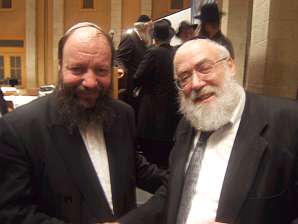 Many readers will remember that in May I wrote that a pro-R' Elyashiv group called the The Vaad HaRabbonim Haolami LeInyonei Giyur was strong within the EJF, and that they were also trying to manipulate the Rabbanut itself to accept their particular standards. This article spells it out, and includes a grat picture of RNE with R' Moshe Klein, Deputy Director of the Conversion Authority (R' Klein is the one with the knit yarmulke).
This will give me the opportunity to continue my posts on giyur 'standards'. The issue sorta died after the RCA-Rabbanut agreement. I'm glad that the hostile takeover failed.
Subscribe to:
Posts (Atom)