10/18/2007

Conversion Collision Course

[Part II of this]


Yesterday, Haaretz reported about an initiative to set up conversion courts that will be independent of the Chief Rabbinate. It is being initiated by the usual suspects - Tzohar, Hakibbutz Hadati, et al - as part of their mounting campaign to replace the Rabbanut with something else (or, more likely, with a milder version of the same darn thing).

Today, they reported about Chief Rabbi Amar's visit to the USA to check out the RCA's revamped conversion procedures, their primary response to the Rabbanut's threat to pull the plug on accepting RCA conversions. This was a huge news item about a year and a half ago, both in the mainstream media and in the blogs (especially this one).

This juxtaposition highlights the schizophrenia that exists within the MO Rabbinate about these issues. On one hand, they (we) feel that their derech in life and in psak is legitimate and that they must stand up to the ever-more machmir and strident haredized rabbinic establishment. At the same time, they poo-poo the Rabbanut and keep making nice because they recognize that they are at the Rabbanut's mercy when it comes to recognizing giyur (this goes for both Rabbanim in the Diaspora and 'unfranchised' Rabbanim in Israel). The MO Rabbinate wants its own identity, yet lives in mortal fear that chareidi elements like the 'Vaad Horabbonim Haolami Leinyonei Giyur' or its bedfellow the Eternal Jewish Family will influence the Rabbanut to basically lump, with perhaps a few exceptions, MO Rabbis in with their Reform and Conservative colleagues.

Personally, I am a proponent of austritt. In order for it to work, though, a few things must happen. First of all, from the Rabbinic side of things, it must be war. No footsie-playing on the side. Tzohar flirts with the RCA (thinking that what the Israeli Rabbinate lacks is the proper training of Rabbis - which it thinks that organizations like YU, the OU, and the RCA can help solve with their great expertise and their massive stashes of US $$ - and not realizing that the real issue is accountability; the minute a community has the power to fire its Rabbi, the Rabbi becomes very, very interested in learning about pastoral counseling), and the RCA likes the attention but must also then kiss the Rabbanut's tuchis. Tzohar itself walks a tightrope between competing with the Rabbanut and playing by its rules. They have lately been declaring war more openly against the Rabbanut, especially with these giyur and kashrut initiatives, but still has to make sure, for its own purposes, that the public keeps faith in the idea of a Chief Rabbinate while working to depose the current one (Pesonally, I am against the idea of a Chief Rabbinate in any form, I just don't think the Israeli public is ready for that).

The second, and most important thing that must happen is the buy-in of the RCA and Tzohar's core constituency, namely, the dati rank-and-file, the kosher-keepers, those who care about Jewish observance. This constituency is different in Israel and America because in Israel there are no denominational affiliations, really. Tzohar can claim to represent the 'dati-lite' and the traditional segments of the population, whereas the RCA only represents Orthodoxy. Be that as it way, the Rabbanut itself lives and dies by public faith. Can this public faith be undermined?

It depends. With regard to kashrut, it's easy. The law can say who has the right to put a certificate in a store window, but it cannot tell people what to put or not put in their mouths. If the people do not think that a Rabbanut-certified restaurant is kosher, then the weight of the law will not get them in the building (unless there is an supplementary certification, which really does not threaten the Rabbanut as long as they get their check in order for the Badatz to get theirs). Similarly, if people are convinced that something is kosher despite the lack of certification, then the lack of a sticker will not serve as a deterrent (especially if it is certified by another agency). Thus, the Rabbanut’s kashrut apparatus relies on public faith (and, ultimately, the dues paid by the food seller)in their process. If that faith is undermined, then the apparatus collapses, laws notwithstanding. The Heiter Mechirah controversy has created a perfect storm for another organization to step in and usurp the Rabbanut's role.

With regard to marriage and conversion, it is much more complicated. To a degree, people can vote with their feet in these matters as well. They can live together out of wedlock. They can get married civilly in a foreign country. They can find a rabbi who is willing to (risk arrest and) perform an ‘unofficial’ halakhic wedding. Here again, public faith plays a role, but it is a bit more complicated: the cost of not playing ball with the Rabbanut is much higher. Of course, the Rabbanut wants people to get married in Israel, according to ‘the law of Moshe and Israel’; for the most part, the people want the same thing. If everyone would stop caring about whether the Rabbanut considers me Jewish or not, or stopped caring about marrying Jewish or about mamzerut, etc., then its power would be broken. But people do not want to stop caring.

Furthermore, kashrut makes money, but weddings and conversions do not. Registries and databases cost money (though not too much anymore), the Rabbi must spend a lot of time with the couple and on the ceremony, and the fact that the Rabbanut is so well funded - by the government - makes it difficult to imagine that people will put up the money for a new apparatus when their taxpayers' NIS already pay for a local Rabbi. This, ultimately, is the biggest problem of all. The Rabbis who are 'official' have very cushy jobs and much security. Those who do not will not be paid by private initiative, because there's simply no money for that. So people make do with the imperfect current situation. Tzohar has already done what it can with regard to marriage, even getting the Rabbanut to begin changing from within. Truly breaking the Rabbanut's monopoly, however, may take decades, and must begin with those few brave sould who are willing to actually break the law to have an unsanctioned but halakhic wedding or conversion.

Sealing Sodom's Fate

The city of Sodom is encountered three times during the story of Avraham. The first time is when Lot decides to take up residence there. Already then, the Torah reports that "the people of Sodom were very wicked sinners before God". The second time is during the war of the four kings against the five kings, where Avraham rescues the people of Sodom and returns them to its king. Finally, in next week's parsha, the city of Sodom is destroyed as punishment for its wickedness.

Why the wait? Sodom was wicked from the start; what happened between the first encounter, when Sodom is already wicked, and the third, when it is destroyed? The second encounter, of course.

In the second encounter, the King of Sodom meets Avraham. Their meeting is very awkwardly broken up by the apparently simultaneous meeting between Avraham and Malkitzedek. I think that the key to understanding Sodom's destruction lies in this encounter.

Avraham had just won a decisive battle. The people of Sodom had been captured and enslaved, and Avrhaham had come into possession of them and their belongings. And he gives it all back. he was entitled to the property and even the people, as the verses make clear. In fact, the Gemara (Nedarim 32a) finds fault with Avraham that he had the opportunity to bring the people of Sodom under the 'Wings of the Divine Presence' but did not. Had could have had, quite literally, a 'captive audience' for his Kiruv seminars. But he let them go, and even gave back their property, though he allowed his soldiers to justifiably partake from the spoils and also gives 10% to God (indeed, Abraham is seen here withstanding the last temptation of Christ well before Jesus does).

There are really two ways to look at Avraham at this point. Malkitzedek sees Avraham as a saint, someone blessed by God. Avraham fights and wins, but refuses the trappings of victory because he fights for God. The King of Sodom sees Avraham as a monumental frayer. After seeing Avraham part with 10% of the spoils, he tries to beg Avraham for help, and ends up getting even more than he was bargaining for.

We would expect that encountering such incredible magnanimity, that Sodom, starting with the king, might have taken it to heart. It's one thing to be cruel. Lots of people are cruel. It's another thing to be the beneficiary of charity, to truly encounter compassion and mercy at its best, and then to go right back to evil. If the point of Avraham's career was to spread the word of God through acts of kindness and love, then Sodom was his greatest failure, though not for lack of trying. They thus forfeited their claim on the land of Israel, as recorded in the words of the Nevi'im, and were destroyed.

RatRabbi II

Josh just posted his take on the picture of Reb Yeshayaleh of Kerestierer. He connects it to the Christian (or perhaps, taking it even further back, the pagan) idea of a patron saint. I had thought about that connection as well; truth is, it exists in pretty much every culture. That's why I don't think it's 'darkei ha-Emori'; people don't put up the picture to 'be like goyim. They put it up to get rid of the darn mice.

I think I figured out the secret to this segulah, though. As I was reading Josh's post, my 16-month old son was running around the room. when he saw the picture on my screen, he exclaimed "Cat! Meow!". I actually repeated the experiment twice more. He identified the picture as a cat in 2 of the 3 instances, and just looked and smiled in the third instance. So perhaps that's it; Reb Yeshayalah, in this picture, anyway, looks somewhat catlike. Perhaps there's something to this. I have heard of people hanging pictures of owls as a 'segulah' to ward off pigeons. Alternatively, my son has a limited vocabulary and his cognitive development has placed him at the beginning of the Piagettian stage of symbolic representation. If something moves but does not look like an immediate family member, it is a 'cat'. Mice, on the other hand, can probably distinguish between 'cat's' an 'things which move but do not like to eat us or kill us'.

Two harry Potter-related questions:

  1. Would a pic of Reb Yeshayaleh have warded off Scabbers? Might depend how the segulah works, no?
  2. What would Reb Yehsayaleh's Patronus have been? A mouse or a cat?

Finally, I have a cousin who works for a company which makes glue traps. I suggested to him that if he would start putting the picture of R' Yeshayaleh on the package, he would absolutely corner the Chassidishe mousetrap market, which is no doubt formidable. If you're reading this, I expect a cut ;-)

10/17/2007

Past Lech Lecha Posts

For some reason, Lech Lecha seems to have a disproportionate number of past posts connected to it. Here they are:

I've got another one sitting in my belly; I hope to find the time to write it up.

Home Sweet Home

I'll be discharged today. The assumption is that it is indeed Guillian-Barre, though apparently an extremely mild case. There will be some follow-up, but it seems that I'm cured.

I don't know what contributed to the quick process. Early detection - I doubt I would have noticed anything wrong had I not been on a hike - and early treatment probably played a role. The fact that I'm still on the younger side of things (or so I keep telling myself) may have helped. And let's not forget prayer (the prayers of others; I'm not sure I davened for myself, other than the standard brachot in Shemoneh Esrei. I will 'bentch gomel' when I get the opportunity.

Some (like my wife) have mentioned my attitude as a factor, but I don't buy it. I'm not a big believer in 'mind over matter' or 'laughter is the best medicine' -type approaches. As Jack Handey said, “Dad always thought laughter was the best medicine, which I guess is why several of us died of tuberculosis.”

I probably won't be posting so frequently once my nose gets back to the grindstone (and I'm actually very much looking forward to that), but that's to be expected. Here's a link to a fellow who I went to yeshiva with who is suffering from a rare blood disorder. He's got that mix of humor and information that I've been striving for, but he seems to be in for a much longer haul. Refuah Sheleimah. It's a great blog, but would probably be a bit weird if you don't actually know the guy.

I feel a bit guilty for absorbing so much sympathy for what ended up being a painless and relatively minor ailment, though I am certainly grateful for it. And, in truth, the very fact that I was away from home made things difficult there; it isn't easy to be a single parent. The help we had with the kids and with people cooking meals was fantastic.

10/16/2007

Links

YU vs. UMD II (link) - and while you're there, check out this. Seems like the Commie is getting pretty interesting.

NYT on SYs (link)

Interesting/cute videos:

10/15/2007

Virtual Bikur Cholim

Yesterday, during his second prolonged visit to the hospital, my friend (and commenter and photographer) Elli Schorr and I discussed the meaning of the term' le-vaker' in its original sense. He contends, in a convincing manner, that it really means 'to concern one's self' or 'to contemplate'. From this, the modern opposing senses of 'to visit' and 'to criticize' or have a common ancestor. Perhaps 'bikur rofim' - 'doctor's check-up'  - maintains both senses. With this understanding, the FAQ about the apparent contradiction at the beginning of Psalm 27 (Le-David Hashem ori) between 'la-shevet' and 'le-vaker' fals away. le-vaker is not 'to visit', but 'to meditate upon', paralleling 'la-hazot' (to gaze upon) which also appears in the verse, as an activity that one does while dwelling in God's house.

there is an implication for the mitzvah of bikur cholim as well. Whereas the ubiquitous manner in which the mitzvah is generally performed is by actually visiting the ill, any act which manifests concern for the diseased or disabled falls under the rubric as well. This would include helping the sick person's family, but would also include virtual communication (phone, email, blog comments, facebook wall writing, etc.).

[In truth, the Schorrs helped us out once before, though without even realizing it. when our daughter Ruchama was born and spending a lot of time in the hospital (there are a few old blog posts about several aspects of this prolonged ordeal), we had a tremendous amount of help from a family who had gone through a hard time with their oldest daughter and were in position to help us cope with it. They, in turn, were helped by the Schorrs during their ordeal. The family in between has helped us out this time around as well and are also long-time readers and commenters on the blog. And the Burgers Bar was awesome ;-)]

For a while now, I have gotten the sense that this medium, the blog, this strange hobby which will soon celebrate its upsherin, has developed into something of a real community, albeit a virtual one. Sure it's about Torah, news, rants, or whatever else might occur to my ADD mind; but that obscures the fact that the conversation develops out of a real, though virtual, sense of community. Like you don't shmooz with someone at a kiddush unless the relationship is already there.

The outpouring of affection and concern that has come through as a result of my current situation has really reinforced that feeling. The virtual Bikur Cholim, which is a very real type of Bikur Cholim, has been wonderful. Clearly, the blog is only a part of it. the relationships are very real, and transcend whatever might happen because of a website. But the opportunity to share, to continue our conversation from my hospital bed, through emails, visits, phone calls, blog comments and posts on my facebook wall - especially those of you who have volunteered to get beaten like rented mules by playing Scrabble on-line with me (I'm 14-1 so far). Thanks also to the many people who have helped Pesha out with the kids. She's having the hardest time of all. It is all Bikur Cholim, plain and simple, if a bit unconventional.

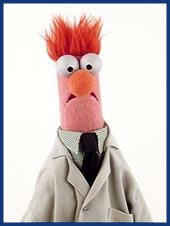
Finally, whenever I hear about Bikur Cholim, this is the image that comes to mind:

10/13/2007

Making Sense from Illness?

So I've been here for about 4 days now, and I've had ample opportunity to reflect on the situation. Many have commented to me that 'my spirit/ matzav ruach' has been excellent. That may well be. The way I see it, there's really no reason to be down. If I were in pain, it might be different. But I'm not, so why shouldn't I continue to have a good time?

Additionally, this relates to the whole 'why' question. Should I be asking why something like this happens? Is there an answer? Personally, I haven't really asked the question seriously. Perhaps that's a Calvinesque response: there's a strip in which he and Hobbes get into a sledding accident and Calvin says "Careful, we don't want to learn any lessons from this." i think this is fundamentally different, though. There, he is actively making sure that experience is not a teacher. In my case, there's no 'experience' to learn from. I did not get into this situation by making some type of error in judgment, at least not in any type of physical causal sense.

Therefore, my attitude is simply to try making the best of an annoying situation. For years now, I have tried to live by an attitude whereby I live life as it comes, not trying to live too much in the past, not trying to mortgage too much to the future. The situation is what it is - no sense dwelling on the coulda, shoulda, wouldas if it will just create a sense of despondency and despair. By all means, take stock, learn from the past; but don't dote on it. Life is happening now. So as I sit here in the hospital, I refuse to feel sorry for myself (though I do feel sorry for my wife, who is truly bearing the brunt of my absence) or to think of this predicament as 'punishment'. It's life. It happens. I will judge myself only the way I handle the situation, and will not entertain metaphysical questions.

As an exercise in my own amusement, perhaps with a bit of a cutting edge, I've thought about the possible spiritual 'causes' for this illness.

The first possibility relates to the fact that this is an autoimmune condition. My father suggested that I have been selling myself short in various aspects of my professional life. I've been 'attacking' myself, weakening myself by settling for subpar opportunities. Perhaps. Definitely something to think about for the long term. Heck, I'm 31 and have no idea what I'll be doing in 5 years.

Another idea is that since this affects my walking, it could reflect a flaw in my 'halicha' in a broader sense. Perhaps I am not serious enough about 'halakha'. perhaps I need to re-think my stance on life, my path toward God, or my commitment to Torah (cf. Rashi to 'im bechukotai telechu')

Alternatively, this condition affects my antibodies, which, in Hebrew, are called 'nogdanim'. Perhaps I'm a bit too contrarian, and should shut this blog down. Nah.

Finally, this condition attacks the myelin sheath around the nerves. I'm literally getting on my own nerves. Perhaps this is because I have gotten on the nerves of others.

These are all things worth thinking about, yet none of them will make me lose sleep. I'll keep trying to become a better guy, whether or not I have GBS. At least I hope so.

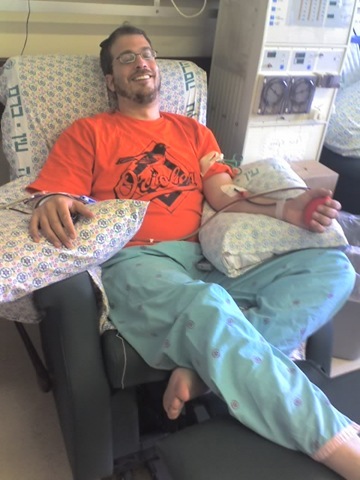
JUST RECIEVED: A picture of me undergoing plasmapheresis

parapheresis

10/12/2007

Long Lost Relatives

On the first day of Sukkot, while looking at some old family pictures at my parents’ home, I came across some photos that my mother had taken when she visited Germany about 15 years ago. The pictures were of the graves of my great-great grandparents, Reuven and Sarah Gummersheimer. I had not known much about my maternal grandfather’s family, and certainly not about his grandparents. His surname was Levi, which makes it very hard to trace any genealogies, since there are many, many Levis out there. But how many Gummersheimers could there be? I decided to try a bit of research on the Gummersheimer family name after Yom Tov.

After a bit of searching, I came across this website of a fellow who has been researching his own family tree for several decades. He had two Ruben Gummersheimers listed in this particular family tree. One had the same birth date, but slightly different death date, than what appears on the headstone. He also was the son of Benedikt Gummersheimer, which would correspond to the Baruch which appears on the headstone. The death date confusion could be explained by something hard to read on the headstone concerning moving dates and the actual death date. In the family tree, Ruben’s wife and any descendants are not mentioned.

Feeling confident that I had discovered a long-lost relative, I contacted the siteowner and introduced myself. Not surprisingly, we are indeed distant relatives. Moreover, the fellow, who is approaching 90, lives just a few blocks away from where I grew up, in Baltimore, and lives even closer to where my grandfather, Ruben Gummersheimer’s grandson, used to live. So I asked my new-found cousin if he even knew my grandfather, Eric Levi, since they lived so close.

As it turns out, this gentleman, in the early 1980s, had come into possession all sorts of family documents in German, and was ready to throw it all away. Coincidentally, around that time he met my grandfather, who encouraged him to pursue genealogical research and offered to translate the documents into English. While going through the documents, he saw that some of this man’s ancestors hailed from the southwestern German town of Bonfeld. My grandfather mentioned that he also had relatives in Bonfeld and that perhaps, someday, they would discover a family connection.

My grandfather passed away in 1992. Fifteen years later, I stumbled across this man’s web-based research and made the family connection.